Let me ask you something.
Have you ever felt like your factory is working hard… but profits still feel tight?
Machines are running. Orders are coming. Employees are busy.
And yet—something feels off.
That “something” is usually a lack of systems.
This is where Odoo ERP for manufacturing industry steps in—not as just another software, but as your business command center.
Let’s break down how it actually changes the game.
Why Indian Manufacturers Are Shifting to ERP?
Across cities like Rajkot, Ahmedabad, Pune, and Coimbatore, I’ve seen a pattern.
Growing manufacturers face:
- Increasing labour costs
- Inventory mismanagement
- Delayed production cycles
- Poor decision-making due to a lack of real-time data
And here’s the catch—most of these problems are invisible leaks.
You don’t notice them daily. But at the end of the year, they quietly cost you ₹10–₹50 lakhs or more.
That’s why ERP adoption in India is rising rapidly.
According to Reserve Bank of India insights on MSME efficiency and digital adoption, businesses leveraging digital systems show significantly improved operational control and financial discipline.
Top 6 Benefits of Odoo ERP for Manufacturing Industry
1️⃣ Real-Time Data = Smarter Decisions (Not Guesswork)
Earlier, you probably relied on:
- WhatsApp updates
- Excel sheets
- Verbal confirmations
Let’s be honest—that’s risky.
With Odoo:
- Every department feeds into one live system.
- You see real-time stock, production, sales, and cash flow.
- No duplicate or wrong entries
👉 It’s like moving from an intuition-based business to data-driven leadership
Quick Example (India Scenario):
A Rajkot-based casting manufacturer reduced wrong purchase decisions by 35% just by seeing real-time stock before ordering.
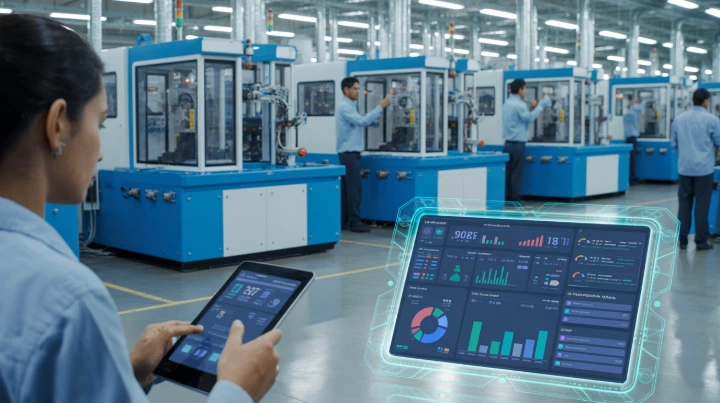
2️⃣ Full Production Visibility – Like CCTV for Your Operations
Imagine this for a moment:
- You walk into your factory floor—or even just open your laptop—and within seconds:
- You know which machine is sitting idle.
- You catch delayed orders before the client calls.
- You see exactly which employee is overloaded.
No guesswork. No chasing updates.
That’s the power of ERP—complete, real-time transparency.
Earlier, you had to call supervisors, check registers, or wait for reports. Now?
You simply open your dashboard—and your entire operation unfolds in front of you like a live control room.
What You Can Track (Without Running Around):
- Work orders in progress
- Machine efficiency and utilisation
- Production stages at every level
- Downtime reasons (and how often they happen)
👉 The result? Less chaos. More control. And decisions that actually drive your business growth.
3️⃣ Cost Reduction That Actually Reflects in Profit
Let’s talk money—the part everyone cares about.
Without ERP:
- Raw material gets wasted.
- Production planning is inefficient.
- Overproduction blocks cash.
With Odoo ERP for manufacturing industry:
- You track the exact cost per job/order.
- You reduce unnecessary purchases.
- You optimise machine usage.
📊 Cost Comparison
| Raw Material Usage | Wastage | Optimized |
| Production Planning | Manual | Automated |
| Cost Visibility | Approximate | Accurate |
| Profit Margin | Unstable | Predictable |
👉 Result? Many SMEs save ₹15–₹40 lakhs annually.
4️⃣ One Platform for All Departments (No More Silos)
Here’s a classic Indian business problem.
Sales says, “Order dispatch karo.”
Production says, “Stock nahi hai.”
Purchase says, “Order already diya tha.”Confusion. Delay. Frustration.
Odoo solves this by connecting:
- Sales
- Purchase
- Inventory
- Accounts
- HR
Everything runs on one system.
👉 No miscommunication. No blame game.
5️⃣ Automated Supply Chain = Faster Delivery, Happy Clients
Let me paint a real situation.
You get a big order.
You start production.
Midway—you realise raw material is missing.
Now what? Delay. Panic. Client pressure.And the worst part? Your reputation takes a hit.
With ERP:
- The system auto-checks your stock levels in real time.
- It creates purchase orders automatically when stock goes low.
- It plans production based on actual demand, not guesswork.
No last-minute surprises. No firefighting.
Smart Automation Features:
- Reordering rules
- Minimum stock alerts
- Demand forecasting
👉 Your supply chain becomes predictable, not reactive.
6️⃣ Smarter Workforce, Not Just a Hardworking Workforce
In India, manpower is your biggest advantage—and sometimes your biggest headache.
Training is not properly planned. Performance tracking is unclear. And skill gaps are noticed only when something goes wrong.
That’s where manufacturing ERP software quietly changes the game.
- Built-in training modules to upskill your team
- Clear performance tracking—no guesswork
- Smart, skill-based job allocation
No chaos. No confusion.
👉 Your team doesn’t just put in more hours—they deliver better results, with sharper focus.
Tired of matching manufacturing data with your GST tax compliance?
Real-Life Scenario: A Typical Indian Manufacturer
Let’s make this real.
A mid-sized engineering company in India:
Before ERP:
- Monthly loss due to inventory mismatch: ₹5 lakhs
- Production delays: 20% orders are late
- Decision-making: Based on assumptions
After the Odoo solution:
- Inventory accuracy: 98%
- On-time delivery: 90%+
- Profit increase: ~18% within a year
👉 Same business. Same team. Different system.
Conclusion: Growth Needs Systems, Not More Effort
Let’s be real—working harder alone won’t fix operational gaps in your manufacturing business. What you truly need is better visibility into your operations, smarter and faster decision-making, and tight control over your costs. That’s exactly what ERP for manufacturing industry brings to the table. It replaces confusion with clarity and manual effort with smart systems. If you’re serious about scaling your business, improving profits, and staying competitive in today’s market—not just surviving—then this is the shift you need to make.
Ready to Upgrade Your Manufacturing Business?
Don’t wait until problems become expensive.
👉 Book your Odoo ERP consultation today
👉 Identify your hidden losses
👉 Turn operations into profit
The Ultimate Reference
We accept returns within 30 days of purchase, provided the book is in its original condition and accompanied by the receipt. Refunds will be issued in the original form of payment. Please note that certain items, like discounted or final sale items, may not be eligible for return.
Because production alone doesn’t give control—data does. Without a connected system, manufacturers lack visibility into costs, inventory, and delays. Odoo solves this by giving real-time operational insights across the entire production cycle.
Odoo aligns production with actual demand using planning tools and inventory tracking, preventing unnecessary manufacturing and reducing dead stock.
Odoo uses integrated data from sales, inventory, and procurement to plan production schedules, ensuring materials, machines, and labor are properly aligned.
Instead of relying on calls, spreadsheets, or follow-ups, Odoo connects departments into one system where updates happen automatically, improving coordination and reducing delays.
Yes, Odoo provides detailed performance reports on work centers, machines, and processes, helping manufacturers detect bottlenecks and optimize operations.
It integrates quality checks at every stage—raw material, in-process, and final output—ensuring consistency without interrupting workflow.
Odoo supports preventive maintenance by tracking machine performance and scheduling service before breakdowns occur, minimizing unexpected stoppages.
Because it is modular and scalable—manufacturers can start with core production features and expand into inventory, quality, maintenance, and finance as the business grows.