
Engineering companies are known for solving complex technical problems. Yet many struggle with managing field operations efficiently.
One technician reaches the customer site without the required spare parts. Another engineer gets assigned to two locations at the same time. Service updates are scattered across calls and WhatsApp messages, making it difficult to track job progress.
Sound familiar?
For many engineering businesses, the real challenge isn't the field work itself—it's coordinating people, schedules, materials, and billing in one streamlined process.
This is where ERP for engineering industry becomes more than just software. It becomes the backbone of efficient field operations.
With the Odoo ERP software and its dedicated Field Service module, engineering companies can manage scheduling, dispatching, service execution, inventory tracking, and invoicing from a single platform.
Why Engineering Companies Struggle with Field Service Management?
Engineering businesses often face delayed service delivery, poor technician allocation, missing service records, and slow invoicing. These challenges directly impact customer satisfaction, profitability, and operational efficiency. A centralized ERP system helps eliminate these bottlenecks.
Field operations involve dozens of moving parts.
A typical service request may include:
- Customer complaint logging
- Technician assignment
- Site visit scheduling
- Spare parts allocation
- Service execution
- Customer approval
- Invoice generation
When these activities are managed manually, errors become inevitable.
Common Challenges Faced by Engineering Companies
| Challenge | Business Impact |
| Manual scheduling | Technician conflicts |
| Poor dispatch planning | Delayed service visits |
| No live visibility | Lack of management control |
| Paper-based job cards | Data loss and reporting delays |
| Inventory mismatch | Repeat site visits |
| Delayed invoicing | Cash flow problems |
| Customer communication gaps | Poor customer experience |
Many engineering companies realize these issues only after customer complaints start increasing.
What is ERP in Engineering and Why Does It Matter?
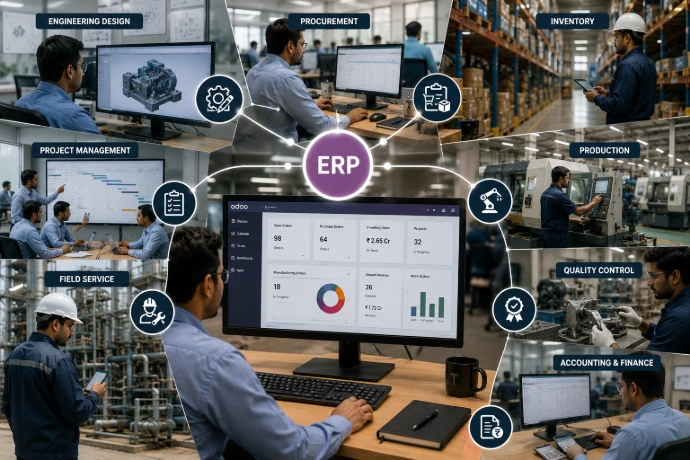
What is ERP in engineering? ERP stands for Enterprise Resource Planning. In engineering companies, ERP connects service, sales, inventory, projects, procurement, finance, and customer management into one integrated system.
Simply put, ERP acts like a control tower.
Instead of different departments working separately, everyone works from the same real-time data.
For engineering businesses, ERP helps manage:
- Service operations
- Installation projects
- AMC contracts
- Spare parts inventory
- Procurement
- Accounts
- CRM
- Customer support
When field service operations are integrated with inventory and finance, the entire process becomes faster and more accurate.
This is one reason why engineering companies participating in India’s manufacturing growth initiatives increasingly invest in digital transformation and automation. According to the Government of India’s manufacturing development initiatives, technology adoption is becoming a key driver of industrial competitiveness.
How Odoo Field Service Solves Scheduling Problems
Odoo Field Service provides a centralized scheduling dashboard that helps managers assign the right technician to the right job at the right time, reducing delays and improving resource utilization.
One of the biggest operational headaches is technician scheduling.Without visibility, managers often assign work based on assumptions.
Odoo solves this through:
Smart Planning Board
The visual planning board displays:
- Available technicians
- Scheduled jobs
- Pending assignments
- Workload distribution
Managers can drag and drop tasks instantly.
Calendar-Based Scheduling
Teams can view:
- Daily jobs
- Weekly schedules
- Emergency service requests
- Installation activities
This reduces scheduling conflicts significantly.
Skill-Based Assignment
Not every technician can handle every job.Odoo allows managers to allocate tasks based on:
- Technical expertise
- Certifications
- Experience level
- Location
This improves first-time resolution rates.
How Odoo Improves Dispatch and Field Coordination
Odoo Field Service provides real-time technician tracking, route planning, and mobile access, helping engineering companies improve dispatch efficiency and reduce travel-related delays.
Dispatch management becomes difficult when technicians are constantly moving between customer locations.
Odoo addresses this with several practical features.
Mobile Access for Field Engineers
Technicians can access:
- Service instructions
- Customer history
- Equipment records
- Checklists
- Work orders
directly from their smartphones.
GPS and Route Visibility
Managers can:
- Track service progress
- Monitor job status
- View technician locations
- Optimize routes
This leads to faster response times.
Real-Time Status Updates
Job statuses can be updated as:
- Scheduled
- In Progress
- Waiting for Parts
- Completed
- Customer Approved
Everyone stays informed without endless phone calls.
How Odoo Integrates Spare Parts Management with Field Service
One of Odoo’s strongest advantages is its integration between the Field Service and Inventory modules. This helps engineering companies ensure spare parts availability before technicians visit customer sites.
Imagine sending a service engineer 60 kilometres away only to discover the required part is unavailable.
That means:
- Extra travel cost
- Delayed resolution
- Unhappy customer
Odoo prevents this through inventory integration.
Key Inventory Features
- Real-time stock visibility
- Spare parts reservation
- Warehouse tracking
- Batch and serial number tracking
- Automated replenishment
Before dispatching a technician, managers can confirm material availability.This significantly reduces repeat visits.

How Odoo Automates Service Reporting and Invoicing
Odoo automatically converts completed service jobs into invoices, reducing billing delays and improving cash flow for engineering businesses.
Many engineering companies still prepare invoices manually after receiving service reports.
This often creates delays of several days.
With Odoo:
Digital Service Reports
Technicians can capture:
- Customer signatures
- Service notes
- Photos
- Spare parts consumed
- Time spent
from their mobile devices.
Instant Invoice Generation
Once a service task is completed:
- Labour charges are calculated.
- Spare parts are added automatically.
- Customer information is populated.
- The invoice is generated instantly.
This accelerates revenue collection.
Before vs After Odoo
| Process | Manual Method | Odoo ERP Software |
| Scheduling | Excel sheets | Smart planning board |
| Dispatch | Phone calls | Real-time coordination |
| Service reports | Paper forms | Mobile reporting |
| Spare tracking | Manual checking | Live inventory |
| Billing | Delayed invoicing | Automated invoicing |
| Customer visibility | Limited | Real-time updates |
Real-World Engineering Success Story
Engineering companies often achieve measurable improvements when field service processes become integrated within ERP.
Consider a growing engineering equipment supplier handling service requests across Gujarat.
Before implementing ERP:
- Scheduling done through phone calls.
- Engineers maintained paper reports.
- Inventory visibility was poor.
- Invoices were delayed by 5–7 days.
After implementing Odoo Field Service:
- Scheduling became centralized.
- Engineers submitted digital reports.
- Spare parts tracking improved.
- Invoices were generated faster.
- Management gained complete service visibility.
The biggest improvement?
Decision-making became data-driven instead of assumption-driven.
This is exactly where an experienced implementation partner like Teknovative Solution can help align technology with operational workflows.
Conclusion
Managing engineering field operations should not feel like solving a daily puzzle.
When scheduling, dispatching, spare parts management, service reporting, and invoicing operate in separate systems, inefficiencies are unavoidable. A modern ERP for engineering industry brings these functions together and creates a structured, transparent workflow.
With powerful features such as smart scheduling, mobile field access, inventory integration, and automated billing, Odoo ERP software helps engineering companies deliver faster service, improve customer satisfaction, and gain better control over their operations.
As Indian engineering businesses continue to scale, the companies that digitize field operations today will be better positioned to compete tomorrow.
Also Read: How Indian Manufacturers Are Using Odoo ERP to Cut Machine Downtime and Boost OEE
Project Delays, BOM Confusion, and Inventory Issues Slowing Your Growth?
Discover how the right ERP solution can bring your design, purchase, inventory, production, and accounts teams onto a single platform.
Curious Minds Want to Know
ERP in engineering is a centralized software system that manages business functions such as projects, service operations, inventory, procurement, sales, and finance from one platform.
Odoo Field Service helps manage scheduling, technician dispatching, service reports, spare parts tracking, customer signatures, and invoicing in a single system.
Field service directly impacts customer satisfaction, equipment uptime, service quality, and revenue collection. Efficient field operations improve customer retention and profitability.
Yes. Once a service task is completed and approved, Odoo can automatically create invoices based on labour, spare parts, and service charges.
Yes. Odoo is highly scalable and suitable for MSMEs as well as larger engineering businesses looking to improve operational efficiency.
Benefits include improved scheduling, inventory visibility, faster invoicing, better resource utilization, centralized data management, and improved customer service.