
Picture this: It's Monday morning in a Pune auto-components factory. Three machines are idle. The maintenance team is hunting for a work order that got lost in WhatsApp messages. The production manager is on a call with a client, explaining why the shipment is delayed again. Sound familiar?
This is not a problem unique to one factory. Across India, from the garment clusters of Surat to the engineering hubs of Coimbatore, machine downtime is quietly eating into profits every single day.
The good news? Odoo ERP for manufacturing is changing that. With real-time dashboards, automated maintenance alerts, and live OEE tracking, Odoo gives manufacturers clear visibility into production performance, machine utilization, and operational bottlenecks as they happen.
In this post, I'll break down exactly how Odoo ERP software helps Indian manufacturers reduce machine downtime, improve OEE, and make better decisions faster.
What Is OEE and Why Should Every Indian Manufacturer Care?
Think of OEE as a health checkup for your factory. Overall Equipment Effectiveness measures how much of your scheduled production time is actually turning into finished, sellable product, and most factories are shocked by the number. Most Indian SME factories run at 40–60% OEE, which means nearly half their capacity is being lost to downtime, defects, or slow cycles.
OEE is calculated using three factors:
| OEE Factor | What It Measures | Typical Loss |
| Availability | Is the machine available and running when needed? | Breakdowns, setup delays |
| Performance | Is it running at full speed? | Slow cycles, minor stoppages |
| Quality | Are parts coming out right? | Defects, rework, scrap |
World-class OEE is considered 85% or above. Most Indian SME plants are far below that, not because of bad workers, but because there is no real-time system tracking what's actually happening on the shop floor.
That's where Odoo ERP software steps in.
How Odoo ERP for Manufacturing Works on the Shop Floor
Odoo's Manufacturing module is built around real-time data capture. Every machine event, production order, and quality check is recorded digitally, giving managers live visibility instead of next-day Excel reports.
Here's what actually happens when you deploy Odoo ERP in a manufacturing plant:
- Work Orders go digital: Instead of paper-based job cards, operators get digital work orders on tablets or shop floor terminals. Each work order is linked to a specific machine, routing, and Bill of Materials (BoM).
- Real-time production tracking: As operators start, pause, or complete tasks, Odoo updates the production order status instantly. Managers see live progress from any device, even a phone.
- Workcenter performance: Every workcenter in Odoo has its own capacity, cost, and cycle time defined. The system compares planned vs actual time and flags deviations immediately.
- Automated OEE calculation: Odoo automatically calculates Availability, Performance, and Quality scores at the workcenter level, no manual Excel formulas needed.
The key Odoo module here is the Manufacturing (MRP) module, which connects directly with Maintenance, Inventory, and Quality modules to give you a unified picture.
Reduce Machine Downtime Using Odoo's Maintenance Module
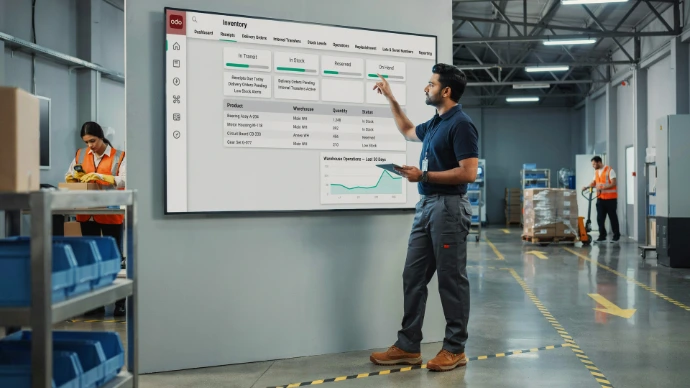
Odoo's Maintenance module moves factories from reactive to preventive maintenance. Instead of fixing machines after they break, you schedule upkeep before problems occur, directly linked to workcenter utilisation data.
This is where Odoo genuinely earns its place on the shop floor. The Maintenance module is not just a calendar reminder tool. It's deeply integrated with production data.
Preventive Maintenance Scheduling:
You can set maintenance triggers based on:
- Time-based: Every 30 days, every 500 hours of operation
- Usage-based: After X number of production cycles or units produced
- Condition-based: When a sensor reading crosses a threshold (using IoT integration)
When a maintenance request is triggered, Odoo creates a Maintenance Request automatically, assigns it to a technician, and links it to the affected workcenter. The production planner can then see the maintenance window and reschedule work orders around it, before any unplanned stoppage happens.
Corrective Maintenance Tracking:
When a machine breaks down unexpectedly, operators raise a corrective maintenance request from the shop floor terminal in seconds. Odoo logs:
- The breakdown was reported immediately.
- The time maintenance team acknowledged
- The time machine was back in production.
This gives you Mean Time To Repair (MTTR) data, which most Indian factories simply don't have. Over time, you can identify which machines break down most frequently and plan capital investments accordingly.
Spare Parts Management:
Odoo links maintenance requests to the Inventory module. If a spare part is needed, the technician can check stock levels, raise a purchase order if it's out of stock, and track delivery, all within the same system. No more scrambling for parts and losing days waiting for procurement.
Real-Time Dashboards: What Managers Actually See in Odoo ERP
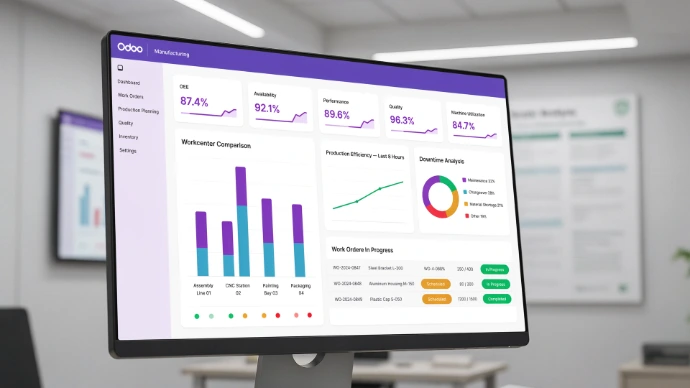
Odoo's real-time dashboards provide manufacturing managers with a complete view of production, machine performance, maintenance activities, and OEE metrics in one place eliminating the need to switch between multiple spreadsheets and reports.
Let me paint a picture of what a production manager sees after logging into Odoo on a typical morning:
| Dashboard Widget | What It Shows | Benefit |
| OEE by Workcenter | Live Availability, Performance, Quality % | Spot bottlenecks instantly |
| Work Order Status | Planned vs In-Progress vs Done | Track daily production targets |
| Maintenance Requests | Open, In Progress, Resolved | No request gets forgotten |
| Scrap & Rework Rate | Scrapped Units per Production Order | Identify quality problems at an early stage |
| Machine Utilisation | % of time each machine is active | Right-size capacity decisions |
| Downtime Reasons | Categorised breakdown causes | Target repeat issues |
The dashboard is fully customisable. You can build a Cockpit view for the plant manager with top-line numbers, a detailed workcenter view for the maintenance supervisor, and a shift-level view for floor supervisors. All relying on a single, real-time source of truth.
Odoo Quality Module: Because Defects Are Hidden Downtime
Poor quality is a silent form of downtime, every defective part means wasted machine time. Odoo's Quality module embeds quality checks directly into production work orders, catching issues at the source.
Here's how it works in practice:
- Quality Control Points: You define checkpoints at specific stages, incoming raw material, in-process, and final inspection. Operators are prompted to record results before they can proceed.
- Quality Alerts: Odoo automatically generates a Quality Alert whenever a measurement is outside of the limit. The issue is escalated, production can be paused, and a root cause analysis is documented.
- Statistical Process Control views: Odoo tracks pass/fail rates over time by workcenter, product, and machine. You can spot drift before it becomes a defect surge.
- Scrap reporting: When parts are scrapped, Odoo records the quantity, reason, and cost, feeding back into your OEE Quality score in real time.
For Indian manufacturers in sectors like auto-components, pharma packaging, or food processing, where quality compliance is non-negotiable, this feature alone can save lakhs in rejected consignments.
Real Talk: How a Rajkot Machine Parts Manufacturer Improved OEE by 22%
A mid-sized machine parts manufacturer in Rajkot, Gujarat, implemented Odoo ERP with Teknovative Solution. Their OEE increased from 54% to 76% in just six months thanks to real-time downtime tracking and preventive maintenance scheduling.
The problem: The plant had 18 CNC machines running on three shifts. Maintenance was reactive, machines would break down mid-shift, and the team would scramble. Average downtime per breakdown: 4–6 hours. Monthly production shortfall: 12–15%.
What changed with Odoo ERP:
- Preventive maintenance schedules are set for each CNC machine based on spindle hours.
- Operators raised breakdown requests from the shop floor in under 2 minutes via tablet.
- Spare parts inventory linked to maintenance, no more waiting 2 days for a bearing to arrive.
- The live OEE dashboard is reviewed every morning in the production meeting.
- Quality checks embedded in CNC work orders, scrap rate dropped from 3.2% to 1.4%.
The result after 6 months: OEE moved from 54% to 76%. Unplanned downtime fell by 68%. The plant manager now runs the morning meeting in 15 minutes instead of 45, because the data is already on the screen.
Odoo ERP vs Traditional Methods: The Real Difference for Indian Factories
Indian manufacturers often rely on a mix of Excel, WhatsApp groups, and paper records to manage production. Odoo ERP replaces this fragmented system with a single, integrated platform, cutting information delays from hours to seconds.
| Parameter | Traditional (Excel/Paper/WhatsApp) | With Odoo ERP for Manufacturing |
| Downtime visibility | Known next day (or never) | Real-time alerts within minutes |
| OEE tracking | Manual monthly calculation | Automated, live by workcenter |
| Maintenance | Reactive, after breakdown | Preventive, scheduled in advance |
| Quality issues | Found at final inspection | Caught at each production stage |
| Spare parts | Based on memory or guesswork | Linked to maintenance requests |
| Reporting | Hours to compile a report | One-click dashboards, any time |
India's Ministry of MSME has been actively pushing digital adoption among small manufacturers through its MSME Digital Transformation Programme. Odoo ERP aligns directly with this initiative, it's affordable, open-source at core, and scalable as your plant grows.
Benefits of Odoo ERP Software Beyond Downtime Reduction
Odoo ERP software is a full business operating system. Beyond manufacturing, it connects your shop floor to finance, procurement, HR, and sales, eliminating data silos that slow down decision-making.Once the Manufacturing module is running, Indian businesses typically extend Odoo to:
- Inventory & Procurement: When raw materials go below the reorder level, auto-replenishment is triggered. Linked to the Odoo Purchase module for automated RFQ generation.
- Accounting & Costing: Odoo Accounting receives actual production expenses (labor, machine time, and material) immediately. No manual entry, no mismatched numbers.
- PLM (Product Lifecycle Management): Manage engineering change orders, BoM revisions, and product versions, all tracked with revision history.
- Sales & Delivery: Customer sales orders are connected to production orders. Promise dates are based on actual capacity, not guesswork.
- HR & Attendance: Attendance, overtime, and operator productivity are all related to work orders. Each production order's labor cost gets calculated automatically.
This integration is where Odoo really pulls ahead. Most Indian factories run 3–5 different software tools that don't talk to each other. Odoo replaces them all.
Wrapping Up
Machine downtime and poor OEE are not factory problems. They're data problems. When you can't see what's happening on your shop floor in real time, you can't fix it fast enough.
Odoo ERP for manufacturing gives Indian factory owners and plant managers the visibility they've been missing, through live dashboards, automated OEE tracking, preventive maintenance workflows, and integrated quality checks. It's not about replacing your team. Giving them the appropriate information at the right time is crucial.
The Rajkot story is not an exception. Across India, manufacturers who have shifted from Excel and WhatsApp to Odoo are running tighter, leaner, more profitable plants.
If you're serious about improving OEE and cutting downtime, Teknovative Solution specialises in Odoo ERP implementations for Indian manufacturers, from shop floor setup to GST-compliant accounting integration.
Read Also: How to Avoid Dead Stock: A Step-by-Step Guide with Odoo Inventory Management Software?
Find Out What's Really Slowing Down Your Production
From unexpected breakdowns to hidden quality losses, Odoo ERP helps you identify bottlenecks and improve shop-floor performance with real-time manufacturing data.
The Ultimate Reference
Quick answers to the most common questions Indian manufacturers ask about Odoo ERP for manufacturing, OEE improvement, and machine downtime reduction.
An OEE score above 85% is generally considered world-class. However, many Indian manufacturing companies operate between 55% and 75%. By monitoring production performance, machine availability, and quality losses through Odoo ERP for manufacturing, businesses can steadily improve their OEE over time.
New machines alone do not solve downtime problems. In many cases, the real issues are poor maintenance planning, lack of production visibility, delayed spare part availability, or inefficient scheduling. Odoo ERP helps manufacturers address these operational gaps using integrated maintenance and production management tools.
Real-time dashboards provide instant visibility into machine utilization, work order status, production delays, downtime trends, and maintenance activities. Instead of waiting for end-of-day reports, managers can take corrective action immediately and prevent small issues from becoming major production losses.
The Manufacturing, Maintenance, Quality, Inventory, and Work Center modules play the biggest role in improving machine utilization. Together, these modules provide real-time production tracking, preventive maintenance scheduling, quality monitoring, and operational reporting that directly contribute to higher OEE.
Yes. Odoo's Maintenance module allows companies to schedule preventive maintenance, track equipment history, monitor recurring failures, and manage maintenance requests. This proactive approach significantly reduces unexpected breakdowns and improves production continuity.
Yes. Odoo ERP is widely used across engineering and discrete manufacturing industries because it supports production planning, machine monitoring, inventory control, maintenance management, quality inspections, and performance reporting within a single platform.