Let me be honest with you.
Growth in an engineering business looks exciting from the outside more orders, more clients, more revenue. But inside? It often feels like everything is slipping out of control.
Production teams are chasing deadlines. Inventory never matches reality. Clients keep asking, “Any update on my order status?”
Instead of scaling the business, you’re stuck firefighting daily chaos.
This is exactly where Odoo ERP for engineering industry starts making sense not as software, but as a system that brings control back into your business.
What is Odoo ERP for Engineering Industry?
Odoo ERP for engineering industry is a smart, all-in-one system that integrates your production, inventory, sales, purchasing, and accounting into a single platform.
Instead of managing different departments with separate tools or Excel sheets, Odoo brings everything together so your entire factory works in sync.
From planning production and managing raw materials to tracking orders and handling finances, Odoo helps you automate operations, reduce errors, and improve efficiency.
👉 In simple words, it gives you complete control over your manufacturing business from raw material to final delivery all in one place.
A Quick Reality Check: Why Most Engineering Businesses Struggle
I’ve seen this pattern again and again.
A company starts small. Systems are simple. Everything works fine.
Then growth happens.
And suddenly:
- Orders increase, but tracking becomes difficult.
- Inventory grows, but control reduces.
- Team expands, but coordination breaks.
At this point, most businesses slip into survival mode just trying to keep things running somehow. But that approach doesn’t scale.
This is where ERP for engineering industry changes the game by replacing guesswork with clarity.
A Real Scenario You’ll Relate To
Imagine this.
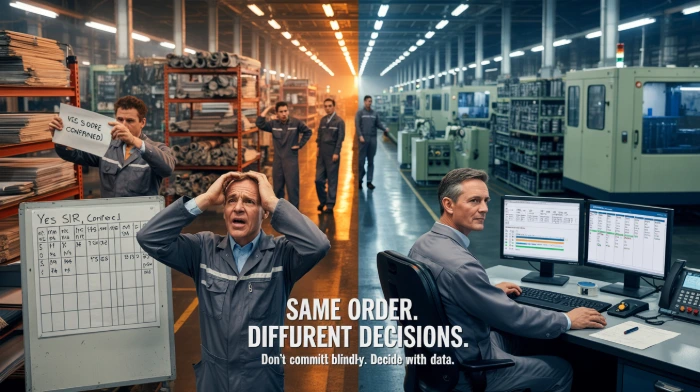
You run a machining or fabrication unit. A client places a big order. Your team says “yes” confidently.
But internally:
- Raw material is not fully available.
- The production schedule is already tight.
- No one has a clear timeline.
You still commit… and then spend the next 10 days firefighting.
Now compare that with a business using ERP software for engineering companies.
Before confirming the order, they already know:
- Current stock levels
- Machine availability
- Delivery timeline
Same business. Same order. Completely different outcome.
How ERP Actually Changes Your Day-to-Day Work?
Before ERP, your day probably starts with questions:
“Where is that order?”
“Is material available?”
“Why is this delayed?”
After ERP? Those questions don’t disappear…
You already have the answers.
1. From Firefighting to Clear Production Planning:
Earlier, production planning felt like a daily puzzle. One delay affects everything. One urgent order disrupts the entire schedule.
With the right ERP for engineering industry, planning becomes visible and structured.
You can actually see:
- Which job is running
- What’s pending
- What needs priority
Stop reacting all day. Start your day with complete visibility and control.
And that changes everything.
2. From “Stock Hai Shayad” to Exact Inventory Control:
Let’s be real. This is not new. You’ve heard this many times:
“Sir, system mein stock toh show ho raha hai… par godown mein kahin mil nahi raha.”
That gap disappears with engineering ERP software.
- Every material movement updates in real time.
- No confusion. No assumptions.
- You don’t over-order “just in case”.
- You don’t stop production because something is missing.
- You just know what’s available.
3. From Endless Follow-Ups to One-Screen Order Tracking:
Earlier, getting an update meant calling 2–3 people.
Sales says one thing. Production says another.
With Odoo ERP software, everything is on one screen.
You check once and you know:
- Order status
- Production stage
- Expected dispatch
Even your clients start trusting you more… because now your answers are clear, not vague.
4. From Gut Feeling to Data-Based Decisions:
This is a big shift.
In growing businesses, most decisions are driven by experience and that’s valuable.
But when you combine experience with data, it becomes powerful.
With ERP, you can actually see:
- Which jobs are profitable
- Where delays are happening
- Which clients or products give better margins
So you stop guessing.
You start deciding with confidence.
Ditch the Complex Sheets
Track your BOM, machine loads, and job cards in 1 click. See how.
The Core Features That Truly Matter
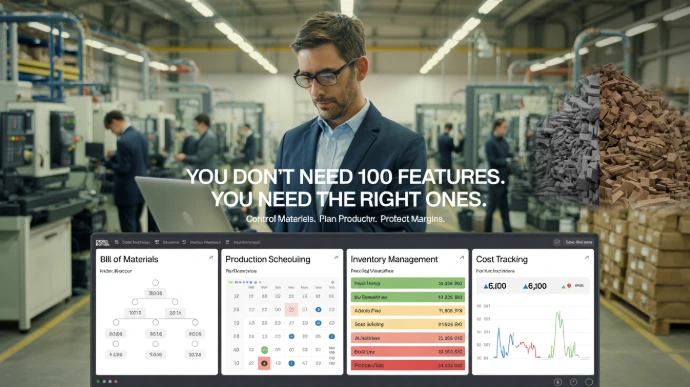
You don’t need 100 features. You need the right ones.
A good engineering ERP system focuses on what actually impacts your business:
- Bill of Materials (BOM): Clear understanding of material usage.
- Production Scheduling: Better control over timelines.
- Inventory Management: No more overstocking or sudden shortages.
- Cost Tracking: Know your real profit, not estimated numbers.
These are not just features they directly affect your margins.
Why Businesses Are Moving Towards Odoo ERP Software Now?
Let’s keep it practical.
Markets are more competitive. Clients expect faster delivery. Margins are tighter.
Operating without a proper system today is like driving without a dashboard you’re moving, but blindly.
According to the Ministry of Electronics & IT, digital adoption among MSMEs is accelerating as businesses focus on efficiency and scalability.
That’s a clear signal. Businesses are not just growing they’re upgrading.
What Happens to Your Profit After ERP?
This is what most business owners actually care about and they’re right.
When you implement ERP for engineering, the impact shows in numbers:
- Better planning reduces wastage.
- Faster execution increases order capacity.
- Clear costing improves pricing decisions.
Even a small improvement in efficiency can create a big difference in profit over time.
It’s not about saving money in one place.
It’s about improving the entire system.
Choosing the Right ERP: Don’t Make This Mistake
Here’s something I’ve noticed.
Many businesses choose ERP the same way they buy hardware based on price or popularity.
That rarely works.
Before selecting any ERP software, focus on fit, not hype.
Ask yourself:
- Does it match how your business actually works?
- Can your team use it easily without confusion?
- Will it support your growth 2–3 years from now?
Because once you implement ERP, changing it is not easy.
Conclusion: Control Is the New Growth Strategy
If your business is growing but feels difficult to manage, that’s not a failure it’s a sign.
A clear signal that your current system can’t support your growth anymore.
ERP for engineering industry gives you control, clarity, and confidence to scale further.
And once you experience that level of visibility, there’s no going back.
If you’re serious about building a business that runs smoothly not just survives it’s time to explore the right ERP solution.
Read Also: ERP Implementation Failures in India: 8 Costly Mistakes to Avoid
Stop Your Engineering Losses
Get total visibility on job margins, production delays, and actual material costs.
Guidebook for Common Queries
If you’re running a small or mid-sized engineering business, the best ERP is one that is affordable, easy to use, and scalable. Many companies prefer flexible solutions like Odoo-based systems because they can start small and expand features as the business grows without heavy upfront investment.
You should focus on features like production planning, Bill of Materials (BOM), inventory management, job work tracking, and real-time reporting. These directly impact efficiency and profitability in engineering businesses.
Excel depends on manual entries, which leads to errors, duplicate data, and delays. As operations grow, spreadsheets become hard to manage, resulting in poor visibility and wrong business decisions that can cost lakhs every year.
ERP connects all departments like production, inventory, sales, and finance in one system. It provides real-time data, automation, and better planning, helping businesses make faster and more accurate decisions.
Companies face issues like data duplication, lack of real-time tracking, poor coordination between teams, delayed reporting, and frequent human errors, which slow down overall business performance.
ERP reduces losses by improving inventory control, minimizing errors, optimizing production planning, and providing real-time insights that help businesses take faster and smarter decisions.
Yes, modern ERP solutions are scalable and cost-effective. They are designed to support growing businesses by improving efficiency, control, and visibility without requiring complex systems.
First, pinpoint the gaps and challenges in your existing processes. Then consult an ERP expert to choose the right solution and implementation plan based on your business needs.