
Let me ask you something, honestly.
Your factory is getting more inquiries. Orders are increasing. Maybe you’re even thinking of expanding machines or hiring more staff.
Sounds like success, right?
But here’s the twist—growth without systems feels like driving a Ferrari in Rajkot traffic without brakes. Fast, exciting… and slightly terrifying.
Most manufacturers I speak with don’t struggle with demand. They struggle with managing that demand without chaos. And that’s exactly where ERP for manufacturing industry steps in—not as software, but as a growth engine.
The Silent Problem No One Talks About
On paper, everything looks fine.
But inside the factory?
- Production teams are chasing materials.
- Sales is promising aggressive deadlines.
- Inventory shows “available,” but the shop floor says “missing”.
- Accounts give clarity… but only at month-end.
You don’t notice it on day one. But as orders grow, these small cracks become expensive leaks.
I’ve seen factories in Rajkot handling ₹2–5 crore annual turnover suddenly hit a ceiling—not because of a lack of demand, but because their systems couldn’t keep up.
Growth Isn’t About Orders — It’s About Control
Being “growth-ready” is not about having more machines or manpower.
It’s about clarity.
A factory that’s ready for growth knows:
- What’s happening on the shop floor right now?
- Which order is profitable and which isn’t?
- Where are delays forming before they become problems?
This is where Odoo ERP for manufacturing changes the game. It connects everything—so instead of reacting, you start controlling.
A Quick Reality Check
Before we go further, just pause and think:
- Are your production plans made in Excel?
- Do you depend on phone calls or WhatsApp for updates?
- Do you sometimes overstock and still face shortages?
If you nodded even once, your factory isn’t inefficient—it’s simply outgrowing its current system.
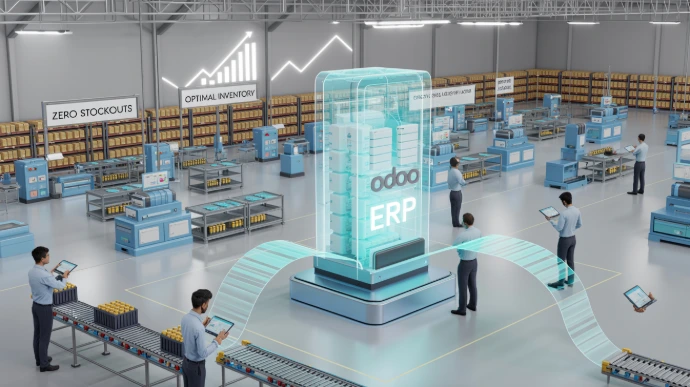
Why Rajkot Manufacturers Are Quietly Moving to Odoo ERP for Manufacturing Industry?
There’s a reason why conversations around ERP have increased in industrial areas like Shapar, Metoda, and Aji GIDC.
And no—it’s not hype.
Odoo ERP for manufacturing is gaining traction because it fits the way Indian factories actually operate.
Here’s what makes it practical:
1. It grows with you:
You don’t need to implement everything at once. Start with inventory. Add production later. Then accounting.
2. It adapts to your process:
Unlike rigid systems, Odoo adapts to your workflow rather than forcing unrealistic changes.
3. Everything connects:
Sales, purchase, production, accounts—one system. No duplication. No confusion.And once this connection happens, something powerful changes:
Decisions become faster—and smarter.
What Actually Changes After ERP?
Here’s a simple way to understand it.
| Before ERP | After ERP |
| Data scattered in Excel | One connected system |
| Guess-based inventory | Real-time stock visibility |
| Delayed production planning | Smart scheduling |
| Month-end profit clarity | Live cost tracking |
This is not magic. It’s just structured information replacing assumptions.
Key Areas Where Odoo ERP Transforms Manufacturing
Instead of listing features, let’s look at impact:
🔧 Production Planning
You stop overloading machines and start scheduling intelligently.
📦 Inventory Management
Dead stock reduces. Shortages reduce. Stress reduces.
💰 Costing & Profitability
You finally know which product makes money—and which one just keeps you busy.
🤝 Sales & Commitments
You promise realistic delivery dates—and actually meet them.
A Ground Reality Example from Rajkot
A mid-sized machine parts manufacturer (₹8 crore turnover) faced a strange issue.
They had too much inventory, yet production kept stopping.
Turns out:
- Raw materials were not tracked properly.
- Purchase decisions were reactive.
- No clarity on actual consumption.
After implementing Odoo ERP for manufacturing, starting with Inventory + MRP:
- Stock accuracy improved within 2 months.
- Production delays dropped significantly.
- Working capital got optimized (less blocked money).
According to a report by the Ministry of MSME, digital adoption can improve the operational efficiency of small manufacturers by up to 20–30%. This isn’t theory—it’s already happening.
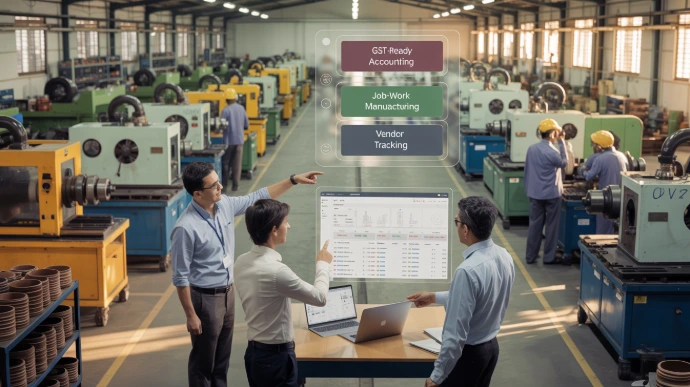
The Role of a Manufacturing ERP Consultant
Let me be frank.
Buying ERP is easy. Implementing it properly? That’s where most companies fail.
A good manufacturing ERP consultant doesn’t just install software—they:
- Understand your workflow (not just features)
- Customize ERP based on your factory reality.
- Train your team in practical scenarios.
- Prevent costly mistakes during implementation.
This is exactly where companies like Teknovative Solution bring value—by bridging the gap between software and actual business needs.
Final Thoughts
Rajkot’s manufacturing future looks strong. Demand will increase. Competition will rise.
The only question is:
Will your factory scale smoothly… or struggle silently?
Adopting ERP for manufacturing industry is no longer a “nice-to-have.” It’s a strategic move.
If you want clarity, control, and confidence in your next phase of growth, this is your moment.
Talk to a trusted manufacturing ERP consultant and take the first step.
Because growth is not the challenge anymore.
Managing it is.
Read Also: Top 7 Indicators Your Factory Needs a Manufacturing ERP Software
Unraveling the Mysteries
A local consultant ensures better customization, real-world training, and faster adoption — increasing chances of success.
Modern systems like Odoo are user-friendly. With proper training, teams adapt quickly.
As orders grow, many factories still rely on disconnected systems, Excel sheets, and manual processes. This creates confusion in production planning, inventory, and delivery schedules, leading to delays and operational chaos.
Growing manufacturers struggle with poor production planning, inventory mismatches, lack of real-time visibility, and coordination issues between departments. These problems increase delays, costs, and customer dissatisfaction.
Odoo uses real-time data, capacity-based scheduling, and automated planning to align demand, resources, and production. This helps factories reduce delays, avoid bottlenecks, and improve on-time delivery.
Odoo provides real-time inventory tracking and integrates stock with production, sales, and purchasing. This reduces stockouts, overstocking, and manual errors, ensuring smooth operations.
Odoo automates processes like production orders, stock updates, and reporting. This reduces human errors, improves accuracy, and allows teams to focus on scaling operations instead of managing data manually.
A business should implement ERP when orders are increasing but operations are becoming difficult to manage, data is scattered, delays are frequent, and decision-making is slow due to lack of real-time insights.