
A machine breaks down while an urgent production order is in progress. Raw materials are delayed, operators wait for instructions, and finished goods miss the dispatch deadline. By the time management identifies the problem, production costs have already increased.
These challenges affect manufacturers of all sizes. AI in Manufacturing offers practical ways to identify operational problems earlier, improve planning, and support better decisions. However, the results depend on data quality, suitable technology, and how well the solution fits existing factory processes.
What Is AI in Manufacturing?
AI in Manufacturing refers to using artificial intelligence to analyse factory data, recognise patterns, make predictions, and recommend actions. It can support decisions on machine maintenance, production scheduling, quality inspection, inventory planning, and energy use. Its main goal is to improve operational decision-making, not to automate every task.
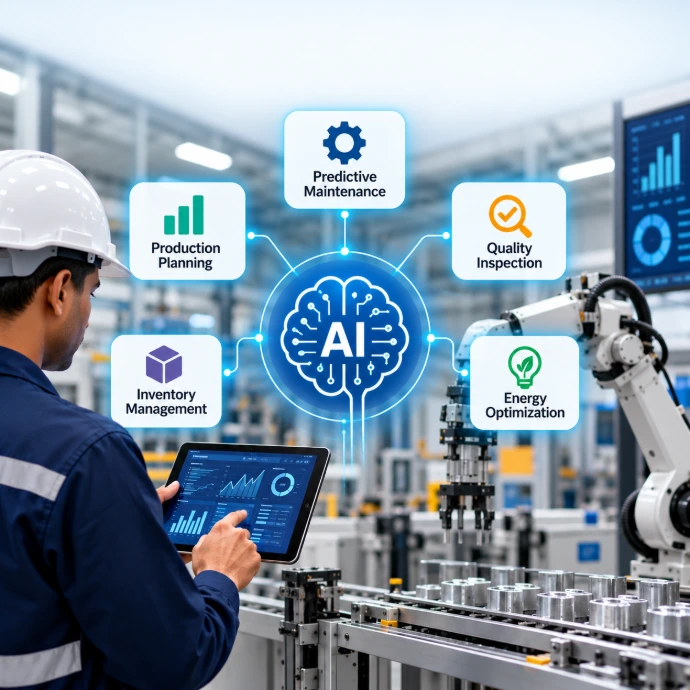
How AI Improves Daily Factory Operations
1. Predictive Maintenance:
Unexpected machine failures disrupt the production schedule and add to the cost of repairs. AI can analyse sensor readings, temperature changes, vibration patterns, and maintenance records to identify signs of an impending machine problem.
For example, a manufacturer may receive an early warning that a machine's operating pattern has changed. Maintenance staff can inspect it before the problem causes an unplanned stoppage. Predictions depend on available data and the reliability of the monitoring system.
2. Production Planning and Scheduling:
Production managers often balance customer deadlines, machine capacity, labour availability, and material shortages. AI is capable of analysing past production times along with current limitations to suggest realistic schedules.
This can help manufacturers identify possible bottlenecks before they affect delivery commitments. Managers must still validate recommendations against actual shop-floor conditions.
3. Quality Inspection:
Defective products increase rejection costs, require reprocessing, and result in customer complaints. AI-powered computer vision can inspect product images to identify visible defects, such as surface damage, dimensional irregularities, or packaging errors.
For example, an appropriate inspection system would help detect any defective parts that may be passing through a manufacturing line. Manual checks and tests are still critical, especially where mistakes in the process may lead to high levels of danger.
4. Inventory Forecasting and Material Availability:
Excess inventory ties up working capital, while material shortages delay production. AI can analyse historical consumption, order patterns, lead times, and demand fluctuations to estimate future requirements.
When connected with inventory and purchasing records, these insights can help purchasing teams plan replenishment more effectively.
5. Energy Efficiency and Downtime Analysis:
AI can identify unusual energy consumption patterns and analyse downtime records to highlight recurring operational problems. Teams can identify whether excess usage or downtime is linked to specific machines, shifts, products, or production processes.
These insights help managers prioritise improvements instead of relying only on assumptions.
Is Your Manufacturing Business Running on Guesswork?
Discover how connected ERP workflows and AI can help you identify production delays, inventory gaps, and business inefficiencies.
Why AI Alone Is Not Enough Without Connected Business Data?
AI needs reliable, relevant data. When sales orders, inventory balances, production records, and purchasing information sit in disconnected spreadsheets, recommendations may be incomplete or outdated.
An ERP for manufacturing industry connects core business processes, including sales, purchasing, inventory, production, and accounting. Odoo ERP for manufacturing records and manages daily operations, while AI uses this data to detect patterns, predict outcomes, and recommend actions.
Odoo ERP software does not automatically include every advanced AI capability. There may be a need for integration, availability of data, configuration, and other tools for attaining certain results.
How Can Manufacturing Companies Start Using AI?
AI technology in manufacturing doesn’t have to start with a costly overhaul of the entire factory. A focused pilot can help establish whether a particular application provides measurable value.
Follow these steps:
- Identify one recurring problem: Select an issue such as machine downtime, material wastage, or production delays.
- Check Data Availability: Verify that maintenance logs, production records, and inventory data are accurate and complete.
- Select a Measurable Use Case: Set a baseline using metrics such as downtime hours, rejection rates, or material shortages.
- Connect Relevant Data: Confirm that the selected tools can access the data they need.
- Run a Pilot: Test the solution on a single machine, production line, or operational process.
- Measure the results: Compare performance against the baseline before deciding whether to expand.
Start with a problem that has a clear business impact and can be measured reliably.
How does Odoo ERP Consulting support AI Implementation?
Odoo ERP consulting can help manufacturers review workflows, configure ERP processes, improve data consistency, and assess suitable integrations. Relevant Odoo applications include Manufacturing, Inventory, Purchase, Quality, and Maintenance.
For instance, a manufacturer dealing with material shortages may need to refine procurement rules and inventory records before implementing AI-driven demand forecasting. Better operational data can make subsequent analysis more useful.
The implementation approach matters. Standard Odoo ERP software functionality, third-party integrations, custom development, and AI capabilities vary by version and configuration. Manufacturers should evaluate the required functionality, integration costs, data security, and ongoing support before committing to a solution.
Common Mistakes to Avoid
- Adopting AI without identifying a specific business problem.
- Using incomplete, inaccurate, or outdated operational data.
- Automating inefficient processes without correcting their underlying issues.
- Ignoring employee training and operational feedback.
- Expecting immediate results without testing a pilot.
- Failing to measure costs, productivity, quality, or delivery performance.
Conclusion
Effective AI adoption begins with understanding factory operations rather than selecting advanced technology. With reliable data and clear processes, AI in manufacturing can support maintenance, production planning, quality control, and inventory management.
Manufacturers should identify one operational challenge, assess their data readiness, and measure the results of a focused pilot. Reviewing existing workflows and ERP for manufacturing industry readiness helps identify which AI opportunities are practical for the business.
Read Also: Where Are Your Manufacturing Costs Going? How to Reduce Waste Without Lowering Quality
Curious Minds Want to Know
AI in manufacturing uses artificial intelligence to analyse operational data, identify patterns, and support decisions about production, maintenance, quality, and inventory. Depending on the use case, it can deliver predictions, suggest actions, or trigger automated responses.
AI can help identify machine problems, highlight production bottlenecks, detect defects, and improve material planning. These insights allow factory teams to investigate problems earlier and make more informed decisions about production resources.
Odoo 20 documents AI agents, AI-supported automation, and MCP-based interaction between compatible external AI agents and authorised Odoo tools. Actual use cases vary based on system configuration, user permissions, and available data.
AI may help reduce costs by identifying avoidable downtime, excessive material consumption, quality defects, and inefficient energy use. Actual savings depend on the problem being addressed, data quality, implementation costs, and whether teams act on the findings.
Small manufacturers can begin with a clear, measurable challenge, such as repeated machine breakdowns or shortages of materials. They should assess available data, run a limited pilot, train employees, and compare results with existing performance before expanding the solution.
AI can help analyse accessible stock, demand, and supplier information to highlight potential shortages. Purchase quantities and supplier decisions should follow the company’s planning rules and approval process.
Odoo ERP software is not always necessary for every AI application. However, connected ERP data for themanufacturing industry can improve visibility across production, inventory, purchasing, and sales, making it easier to analyse business performance and support coordinated operational decisions.
Ready to Make Your Manufacturing Business Smarter?
Let's identify where your business workflows are breaking down and explore how Odoo ERP and AI can help improve visibility, coordination, and decision-making.