
You know that familiar factory story.
Orders are coming in. Machines are running. Workers are busy. Dispatches are happening. Yet, at the end of the month, the profit does not look as healthy as it should.
So where did the money go?
In many Indian manufacturing businesses, the answer is not one big expense. It is a hundred small leaks: excess material consumption, machine idle time, rework, urgent purchases, rejected batches, unnecessary movement, slow approvals, and inventory sitting quietly in a corner.
Manufacturing cost reduction is not about making your factory cheaper. It is about making every rupee work harder without compromising quality.
That difference matters.
Because cutting inspection, using inferior raw material, or reducing maintenance may lower this month's expense. It can also create tomorrow's customer complaint.
The smarter question is: Where is your manufacturing cost actually going?
What Is Manufacturing Cost Reduction?
Manufacturing cost reduction means lowering the total cost of producing a product by removing avoidable waste, delays, excess consumption, and inefficiencies while maintaining required quality and delivery standards. The real objective is to get more value from every rupee you spend. It is to produce the same acceptable output with better use of material, labour, machines, energy, and time.
Think of your factory like a bucket.
If the bucket has five small holes, adding more water will not solve the problem. You first need to identify where the losses are happening.
For a typical Indian manufacturing business, the major cost areas include:
- Raw material and consumables
- Direct labour
- Machine and equipment utilisation
- Power and energy
- Rejection and rework
- Inventory carrying cost
- Maintenance
- Production delays
- Procurement and logistics
- Administrative and approval time
The interesting part? The biggest cost leak is often not where management first looks.
A business may negotiate harder with suppliers while losing far more money through scrap, poor production planning, or repeated rework.
Manufacturing cost reduction starts with visibility. Before trying to cut a cost, understand why that cost exists.
The four major manufacturing cost areas
| Cost Area | Typical Hidden Waste |
| Material | Scrap, excess consumption, obsolete stock |
| Labour | Idle time, overtime, repeated work |
| Machines | Breakdowns, waiting, low utilisation |
| Process | Rework, delays, unnecessary movement |
Real manufacturing cost reduction comes from improving the system, not blindly cutting individual expenses.
Where Are Your Manufacturing Costs Actually Going?
The biggest cost leak is often not a single large expense. It is the combination of dozens of small inefficiencies happening every day.
Consider a machine shop producing industrial components. A machine is technically running for eight hours, but actual productive machining may be only six hours. The remaining two hours disappear into setup, material waiting, tool changes, inspection delays, and operator waiting.
Now multiply that by 10 machines and 25 working days.
The number becomes uncomfortable.
Look beyond the purchase price
A ₹100 component is not necessarily cheaper than a ₹110 component.
Suppose Supplier A sells at ₹100 but has:
- 5% rejection
- irregular delivery
- inconsistent dimensions
- frequent follow-ups
Supplier B sells at ₹110 with stable quality and delivery.
Your real cost may be lower with Supplier B.
This is why manufacturing cost control should consider the total cost of ownership, not just the invoice price.
Five questions every manufacturer should ask
- How much material becomes scrap every month?
- How many production hours are lost waiting?
- How much rework happens after production?
- Which products consume the most working capital?
- Which production delays repeatedly create overtime or urgent purchases?
If these numbers are not visible, cost control becomes guesswork.

7 Practical Manufacturing Cost Reduction Strategies That Actually Work
Manufacturing cost reduction strategies work best when they attack the reason behind waste. Start with the process that repeatedly creates losses, measure it, identify the root cause, and then change the workflow.
Here are seven areas worth examining.
1. Measure material loss, not just material purchase:
Many manufacturers track how much raw material they purchase but not how much should theoretically be consumed for a particular production order.
For example:
Standard consumption: 10 kg
Actual consumption: 11.2 kg
Difference: 1.2 kg
That difference looks small.
Across 500 production orders, however, it becomes 600 kg of unexplained consumption.
Track:
- Standard quantity
- Actual quantity
- Scrap quantity
- Reusable scrap
- Material variance
- Reason for variance
This creates a practical foundation for manufacturing waste reduction.
2. Stop treating rework as “normal”:
One of the most expensive sentences on a factory floor is:
“Thoda rework toh chalta hai.”
No. It doesn't.
Rework consumes material, labour, machine capacity, electricity, and production time. Worse, it can delay other orders.
Track rework by:
- Product
- Machine
- Operator/team
- Defect type
- Production batch
- Root cause
If 60% of rework comes from one recurring defect, solving that defect can deliver more savings than cutting five smaller expenses.
3. Reduce machine waiting time:
A machine cannot generate value when it is waiting for material, drawings, tools, approvals, or another process.
Create a simple machine downtime and waiting-time register.
Classify lost time into:
| Reason | Action |
| Material unavailable | Improve material planning |
| Tool unavailable | Maintain tool inventory |
| Drawing pending | Improve document approval |
| Machine breakdown | Preventive maintenance |
| Quality hold | Fix recurring quality issue |
| Operator unavailable | Improve manpower planning |
This is a direct route to manufacturing efficiency improvement.
4. Plan purchasing from production reality:
Urgent purchases are expensive.
When purchasing teams receive last-minute requirements, they may pay higher prices, accept inconvenient quantities, or choose faster but costly transport.
A better system connects:
Sales Order → Production Plan → Material Requirement → Purchase Requirement → Supplier Delivery
This is one area where ERP for manufacturing cost reduction becomes practical.
With an ERP such as Odoo, production and purchasing information can be connected so that material requirements are based on actual orders, bills of materials, and inventory levels rather than scattered Excel sheets and WhatsApp messages.
The objective is not “using ERP”.
The objective is buying the right material at the right time and quantity.
Find Where Your Manufacturing Costs Are Leaking
Get a clearer view of material waste, production delays, rework and inventory costs — and identify where you can reduce manufacturing costs without compromising quality.
How ERP Helps With Manufacturing Cost Reduction
ERP can make manufacturing cost reduction much easier by bringing production, inventory, purchase, quality, and accounting data into one system.
The biggest advantage is visibility. Instead of checking different Excel sheets and asking different departments for updates, you can see where your production cost is increasing and investigate the reason.
For example, an ERP like Odoo can help you compare:
- Planned vs actual material consumption
- Expected vs actual production cost
- Scrap and rework levels
- Inventory requirements
- Production delays
- Purchase requirements
Suppose a product should consume 100 kg of raw material, but production regularly uses 108 kg. ERP can help you identify this variance and investigate whether the extra 8 kg is going into scrap, rework, or process loss.
The same applies to inventory and purchasing. Better production planning can help avoid overstocking, urgent purchases, and material shortages — all of which directly affect manufacturing costs.
So, ERP is not about simply adding more software to your factory.
It is about getting the right information at the right time so you can find cost leaks earlier and take action before small losses become big expenses.
ERP supports manufacturing cost reduction by giving you better visibility and control over the activities that create production costs.
Manufacturing Cost Reduction Is Not the Same as Cost Cutting
Cost cutting removes spending. Manufacturing cost reduction removes waste and inefficiency.
That distinction matters.
| Cost Cutting | Cost Reduction |
| Reduce inspection | Reduce defects |
| Buy cheaper material | Reduce material variance |
| Reduce manpower | Reduce idle time |
| Delay maintenance | Prevent breakdowns |
| Reduce inventory blindly | Improve inventory planning |
| Push workers harder | Improve process flow |
A good example is preventive maintenance.
Spending ₹50,000 on planned maintenance may look like an additional cost. But if it prevents a ₹4 lakh breakdown during a critical production period, the business has reduced its real cost.
The same principle applies to quality.
The cheapest production process is not the one with the lowest immediate expense. It is the one with the lowest total cost while consistently meeting requirements.
For manufacturers looking at process improvement, the Ministry of Micro, Small & Medium Enterprises (MSME) official portal is also a useful government resource for understanding schemes and initiatives relevant to Indian MSMEs.
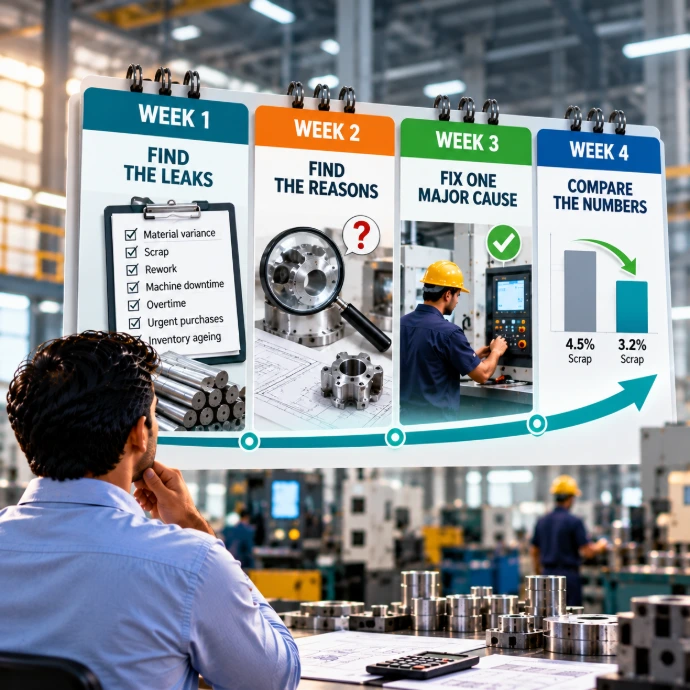
A Simple 30-Day Plan for Production Cost Reduction
You do not need to transform the entire factory in one week. Start with one product line, one plant area, or one recurring problem.
Week 1: Find the leaks:
Measure:
- Material variance
- Scrap
- Rework
- Machine downtime
- Overtime
- Urgent purchases
- Inventory ageing
Week 2: Find the reasons:
Do not stop at “scrap is high”.
Ask why.
Was the material defective?
Was the machine setting wrong?
Was the drawing unclear?
Was the operator using an outdated instruction?
Week 3: Fix one major cause:
Start with the problem that is repeatedly putting the most pressure on your costs.
Create an owner, target, and deadline.
Week 4: Compare the numbers:
Measure before and after.
For example:
Before: 4.5% material scrap
After: 3.2%
That 1.3 percentage-point improvement may look small on paper. Across high-volume production, it can represent meaningful annual savings.
How Do You Know If Your Manufacturing Cost Reduction Is Working?
The simplest test is whether your cost per good unit is falling without hurting quality or delivery.
Track a small set of metrics every month:
| KPI | What It Tells You |
| Cost per good unit | Overall production efficiency |
| Material variance % | Material control |
| Scrap % | Waste level |
| Rework % | Process quality |
| OEE | Machine effectiveness |
| Production plan adherence | Planning quality |
| Inventory ageing | Working-capital leakage |
| On-time delivery | Customer impact |
Do not create 50 KPIs.
If nobody uses the number to make a decision, it is probably just another number.
Manufacturing cost control becomes effective when financial numbers are connected to the operational reasons behind them.
Conclusion: The Real Savings Are Usually Hiding in Plain Sight
Manufacturing cost reduction is rarely about finding one magical saving.
It is about noticing what your factory has started accepting as “normal”.
A little scrap.
A little rework.
A little waiting.
A few urgent purchases.
A machine that breaks down every month.
Stock that has remained untouched for the past 12 months.
Individually, each may look manageable. Individually, these losses may seem small, but together they can steadily reduce your profit margin.
The smarter approach is simple: measure the loss, find the reason, fix the process, and track the result.
And if your production, purchase, inventory, quality, and accounting data are still sitting in separate systems or spreadsheets, that is itself worth investigating. Better manufacturing cost control starts with better visibility.
Read Also: How Long Does Odoo Implementation Take? A Practical Timeline for Indian Businesses
Rapid Assistance Zone
The best approach is to identify recurring waste in material, labour, machines, and processes, measure its financial impact, and fix the root cause rather than simply cutting expenses.
How can manufacturers reduce production costs without reducing quality?
Focus on scrap reduction, rework elimination, preventive maintenance, better production planning, supplier quality, and process standardisation. These reduce waste without lowering required quality standards.
ERP can connect production, inventory, purchasing, quality, and accounting data. This helps manufacturers identify material variance, production delays, inventory problems, and unexpected costs faster.
Manufacturing waste reduction is the process of eliminating activities or resources that consume time, material, or money without adding customer value. Examples include scrap, waiting, rework, excess inventory, and unnecessary movement.
Start by measuring material consumption, scrap, rework, machine downtime, inventory ageing, and urgent purchases. Then use those numbers to identify and fix the biggest recurring sources of cost.
No. A cheaper material can increase rejection, rework, downtime, or customer complaints. The correct comparison is the total cost of using the material, not only its purchase price.