
Growing a manufacturing business in India isn’t as simple as buying another machine, hiring more workers, or taking more orders.
If it were, every factory in Rajkot, Ahmedabad, Pune, Coimbatore, Ludhiana, Faridabad, and Chennai would already be doubling its profits every year.
The reality is different.
Many manufacturers work harder every year but don’t see the same improvement in profitability. Orders increase, but production delays increase too. Sales grow, but cash flow remains tight. Machines become faster, but planning still happens across Excel sheets, WhatsApp messages, and disconnected systems.
Sound familiar?
The real challenge is often not getting more business.
It is building an operation that can handle more business profitably.
At Teknovative Consultation, we look at manufacturing growth from that perspective.
Before asking:
“Which machine should we buy?”
or
“Which ERP should we implement?”
we ask a more important question:
“What is preventing this manufacturing business from growing profitably?”
Sometimes the answer is production capacity.
Sometimes it is inventory.
Sometimes it is poor planning, quality problems, inefficient processes, delayed payments, supplier issues, or excessive dependence on the business owner.
And sometimes the factory already has enough capacity—but isn’t using it effectively.
This guide explains 15 practical manufacturing growth strategies that can help Indian manufacturers improve profitability, productivity, operational control, customer relationships, and long-term scalability.
The Complete Guide to Manufacturing Business Growth in India
(1) Understand Where Your Profit Really Comes From:
Revenue keeps the business moving. Profit keeps it healthy.
One of the biggest mistakes manufacturers make is focusing on sales growth without understanding which products and customers actually generate profit.
You may know your biggest customer.
You may know your busiest machine.
You may know which salesperson brings the most orders.
But do you know:
- Which products have the highest margins?
- Which customers are actually profitable?
- How much does rework cost?
- How much material is wasted?
- What is the real production cost per unit?
- How much working capital is tied up in inventory and receivables?
For example, imagine:
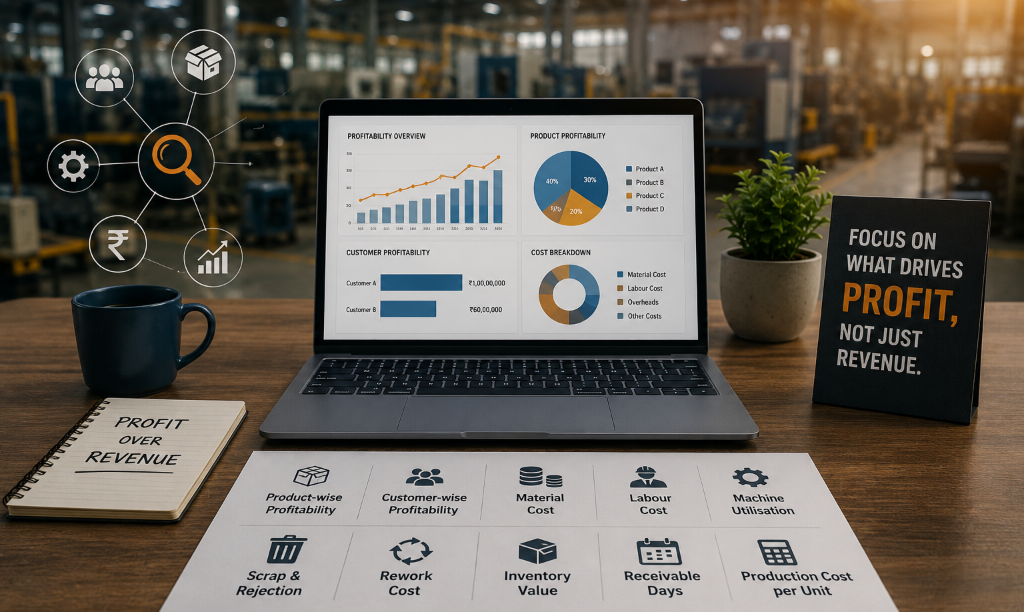
Customer A generates ₹1 crore annually but constantly negotiates prices, demands urgent production, and pays after 90 days.
Customer B generates ₹60 lakh but places regular orders, pays within 30 days, and provides better margins.
Which customer should you grow?
The answer isn’t always the customer with the highest revenue.
Track these numbers regularly:
- Product-wise profitability
- Customer-wise profitability
- Material cost
- Labour cost
- Machine utilisation
- Scrap and rejection
- Rework cost
- Inventory value
- Receivable days
- Production cost per unit
Manufacturing takeaway
Don’t grow revenue blindly. Grow profitable revenue.
(2) Stop Competing Only on Price:
Every manufacturing cluster has competitors willing to quote lower prices.
Trying to beat them on price every time can quickly become a race to the bottom.
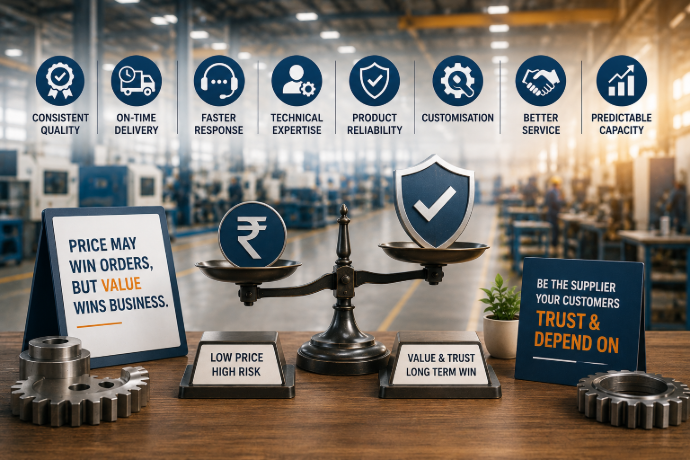
Instead, build your competitive advantage around things customers genuinely value:
- Consistent quality
- On-time delivery
- Faster response
- Technical expertise
- Product reliability
- Customisation
- Better service
- Predictable production capacity
Consider two suppliers.
Supplier A quotes ₹95.
Supplier B quotes ₹105.
Supplier B consistently delivers on time, has fewer quality issues, responds quickly, and rarely disrupts the customer’s production schedule.
For an OEM, the ₹10 difference may be insignificant compared with the cost of a production stoppage.
Your objective should not always be to become the cheapest manufacturer.
It should be to become the most valuable and reliable supplier in your market.
(3) Reduce Waste Before Increasing Capacity:
When orders increase, many manufacturers immediately think:
“We need another machine.”
Sometimes that’s correct.But before investing in additional capacity, find out whether your existing resources are being used effectively.
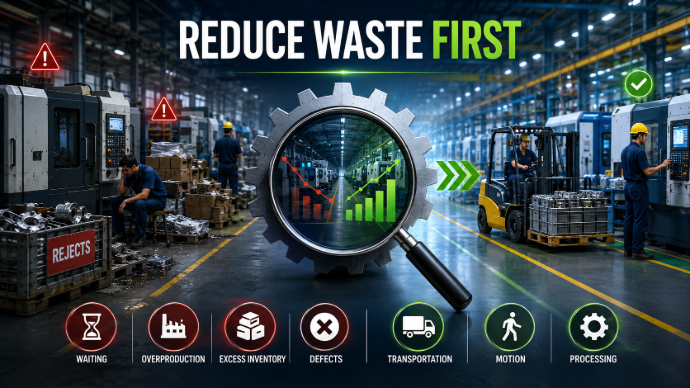
Manufacturing waste can appear as:
| Type of Waste | Example |
| Waiting | Operators waiting for materials |
| Overproduction | Producing before actual demand |
| Excess inventory | Materials sitting unused |
| Defects | Rejection and rework |
| Transportation | Unnecessary material movement |
| Motion | Workers repeatedly walking between areas |
| Processing | Extra steps that add little value |
Also examine:
- Machine idle time
- Long changeovers
- Material shortages
- Poor production scheduling
- Unplanned downtime
- Repeated approvals
- Excessive manual work
Before purchasing another machine, ask:
Are we genuinely short of capacity, or are we poorly utilising the capacity we already have?
That distinction can save significant capital.
(4) Identify the Bottleneck That Controls Your Growth:
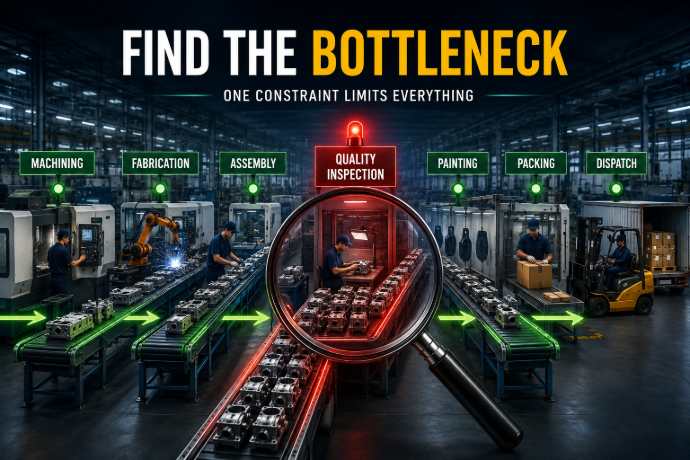
Every manufacturing business has a constraint.
It might be:
- CNC machining
- Fabrication
- Assembly
- Painting
- Heat treatment
- Quality inspection
- Packing
- Dispatch
One slow stage can restrict the output of the entire factory.
For example:
Your production department can manufacture 1,000 units per day, but quality inspection can clear only 700.
Producing more won’t solve the problem.
You first need to understand why inspection has become the bottleneck.
Look for:
- Queues
- Waiting
- Rework
- Manual approvals
- Machine downtime
- Material shortages
- Poor scheduling
- Lack of manpower
The key question
Where does work accumulate before moving to the next stage?
Fix that constraint first.
(5) Improve Production Planning Instead of Fighting Daily Fires:
Many manufacturing businesses begin their day with:
“What should we produce today?”
That question should ideally have been answered much earlier.
Poor production planning can create:
- Missed delivery dates
- Material shortages
- Idle machines
- Excess inventory
- Overtime
- Frequent schedule changes
- Customer complaints
A stronger production planning process connects:
Demand → Material Planning → Procurement → Machine Scheduling → Manpower → Production → Quality → Dispatch
Even a structured weekly production review can make a significant difference.
Instead of constantly reacting to problems, your team starts preventing them.
Good planning should answer:
- What needs to be produced?
- When is it required?
- Which materials are needed?
- Which machines are required?
- Which operators are available?
- What is the production priority?
- Where are the current bottlenecks?
The focus should be on better execution, not more planning. The goal is to create predictable production.

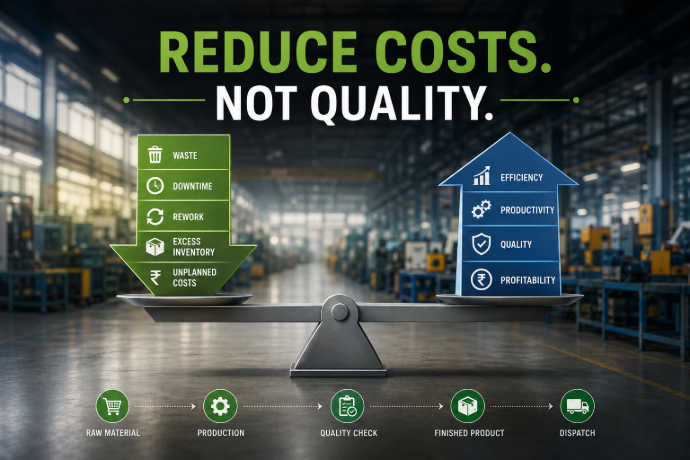
(6) Reduce Manufacturing Costs Without Cutting Quality:
When costs increase, the easiest response is often to pressure suppliers, reduce labour, or increase prices.
But many manufacturing costs are hidden inside daily operations.
Look for:
- Material wastage
- Scrap
- Rework
- Machine downtime
- Overtime
- Excess inventory
- Emergency purchases
- Expedited transportation
- Poor production planning
- Repeated quality failures
For example, a small reduction in material waste can create substantial savings when annual raw-material consumption runs into crores.
Ask:
Where does every rupee go between purchasing raw material and dispatching the finished product?
That question can reveal more opportunities than simply asking:
“How can we sell more?”
The objective
Lower the cost of producing quality—not lower the quality itself.
(7) Make Quality a Production Process, Not Just a Final Inspection:
If a quality problem is discovered only after production is complete, you’ve already paid for the mistake.
You have consumed:
- Raw material
- Machine hours
- Labour
- Electricity
- Production capacity
- Time
And now you may need to pay again for rework or replacement.
A stronger quality system includes:
- Incoming material inspection
- First-piece inspection
- In-process quality checks
- Standard operating procedures
- Quality control points
- Rejection analysis
- Root-cause analysis
- Corrective actions
Quality should be built into the process rather than treated as a final checkpoint.
For Indian manufacturers competing on quality, price, and delivery, consistent quality can become a powerful competitive advantage.
Remember:
Every rejection costs twice—once in production cost and again in customer confidence.
Grow Your Manufacturing Business with Confidence
Discover what's limiting your factory's growth and get expert guidance to improve productivity, reduce costs, and scale your operations the right way.
(8) Build Strong Supplier Relationships, Not Just Low-Cost Purchasing:
The cheapest quotation isn’t always the cheapest supplier.
Imagine one supplier offers material at ₹100 per unit.
Another charges ₹103 but provides:
- Consistent quality
- Reliable delivery
- Faster response
- Better flexibility
- Emergency support
If the ₹100 supplier repeatedly delays your production, the ₹103 supplier may actually be cheaper for your business.
Evaluate suppliers based on:
| Supplier Factor | What to Measure |
| Price | Purchase cost |
| Quality | Rejection percentage |
| Delivery | On-time delivery |
| Lead Time | Days required |
| Reliability | Consistency |
| Flexibility | Emergency support |
| Payment Terms | Working-capital impact |
Also consider sharing production forecasts, maintaining agreed payment schedules, and reviewing supplier performance regularly.
Your supplier network is part of your manufacturing capability.

(9) Shorten the Time From Order to Delivery:
Customers don’t care how complicated your internal process is.
They care when they will receive the product.
Map the complete order-to-delivery journey:
Enquiry → Quotation → Sales Order → Material Planning → Procurement → Production → Quality → Packing → Dispatch
Then measure how long each stage takes.
You may discover that actual manufacturing takes three days—but the order spends another six days waiting for:
- Approvals
- Materials
- Scheduling
- Quality inspection
- Internal communication
That waiting time is an opportunity for growth.
Track:
Order-to-Delivery Lead Time
The shorter and more predictable it becomes, the easier it is to compete for customers who value reliability.

(10) Focus on High-Value Customers, Not Just More Customers:
More customers do not automatically mean better growth.
A customer who generates high revenue but low margins, delayed payments, constant disputes, and unpredictable demand may be less valuable than a smaller customer with consistent orders and healthy margins.
Evaluate customers based on:
- Profitability
- Order frequency
- Payment behaviour
- Repeat business
- Complaint rate
- Growth potential
- Referral potential
- Strategic importance
Build stronger relationships through:
- Faster quotation responses
- Regular customer reviews
- Proactive communication
- Technical support
- Consistent quality
- Reliable delivery
Growing with the right customers is often easier than constantly searching for new ones.

(11) Diversify Carefully and Expand Beyond Your Local Market:
A large customer can accelerate growth.
It can also create significant risk.
If 40–50% of your revenue comes from one customer, losing that account can immediately affect production, manpower, and cash flow.
Build a balanced customer portfolio across:
- Industries
- Regions
- Product categories
- OEM customers
- Distributors
- Export markets
- Contract manufacturing
- Institutional buyers
India also offers opportunities across multiple manufacturing clusters.
A manufacturer based in Gujarat, for example, may explore opportunities in Maharashtra, Rajasthan, Karnataka, Tamil Nadu, Telangana, or other industrial regions depending on its products and capabilities.
Before entering a new market, evaluate:
- Demand
- Competition
- Logistics cost
- Customer concentration
- Distribution requirements
- Service requirements
- Payment behaviour
- Regulatory requirements
Expand systematically:
Research → Implement → Monitor → Improve → Expand
Don’t enter every market at once.

(12) Turn Your Manufacturing Expertise Into a Sales Advantage:
Manufacturers often have years of technical knowledge but rarely use that knowledge as part of their marketing strategy.
Your engineers know:
- Why components fail
- What causes defects
- How material selection affects performance
- How customers can reduce maintenance
- What affects production costs
- Which specifications matter
Turn that expertise into useful content.
Content helps potential customers discover your company before they contact your sales team.
For B2B manufacturing, technical authority can become a sales asset.
Your website should not only say what you manufacture.
It should demonstrate what you understand about your customer’s problems.

(13) Build a Strong Team and Reduce Owner Dependency:
Many industrial companies rely heavily on their owners.
- The owner approves purchases.
- The owner handles important customers.
- The owner solves production problems.
- The owner knows which supplier to contact.
- The owner approves major decisions.
That approach may work for a small business.
It becomes a serious growth constraint as the business expands.
A scalable manufacturing business needs clear responsibility across:
- Production
- Purchase
- Quality
- Stores
- Maintenance
- Sales
- Finance
- Dispatch
Build systems around:
- Cross-training
- Standard operating procedures
- Skill development
- Daily production meetings
- Performance reviews
- Knowledge sharing
Give managers measurable targets and appropriate decision-making authority.

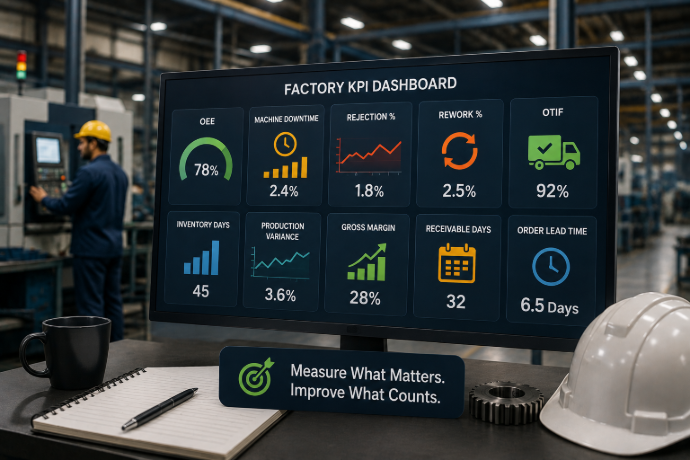
(14) Measure the Factory With the Right KPIs:
You cannot improve what you cannot see.
But that doesn’t mean creating hundreds of reports.
Start with a focused manufacturing dashboard.
| KPI | What It Tells You |
| OEE | Equipment effectiveness |
| Machine Downtime | Lost capacity |
| Rejection % | Quality performance |
| Rework % | Hidden production cost |
| OTIF | Delivery reliability |
| Inventory Days | Working-capital pressure |
| Production Variance | Planning accuracy |
| Gross Margin | Business profitability |
| Receivable Days | Cash-flow health |
| Order Lead Time | Customer responsiveness |
The objective isn’t more data.
It is better decisions, made faster.
For example:
- Rising inventory may indicate poor demand planning.
- Increasing rejection may indicate quality or maintenance problems.
- Increasing downtime may indicate preventive maintenance issues.
- Falling margins may indicate pricing or production-cost problems.
Manufacturing rule:
Measure the metrics that drive decisions—not just the ones that fill reports.
(15) Use Manufacturing Technology to Make Growth More Scalable:
Technology should not be the starting point.
The starting point should be understanding the business problem.
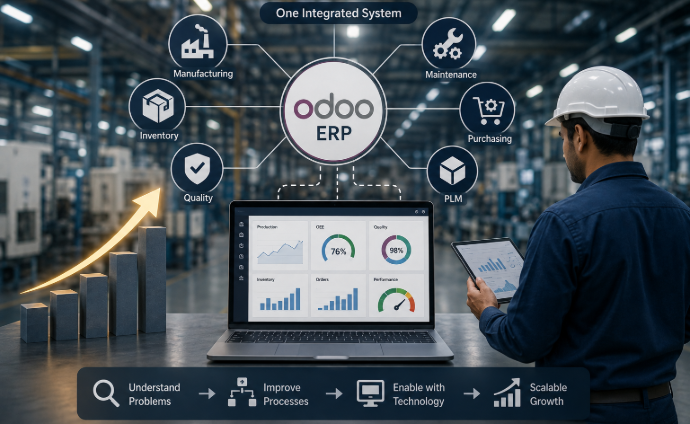
If production, inventory, purchasing, quality, maintenance, sales, and finance are operating through disconnected systems and spreadsheets, it becomes increasingly difficult to maintain visibility as the business grows.
This is where an integrated manufacturing ERP software can become valuable.
When the need exists, an integrated Odoo ERP system can unify key business functions within a manufacturing operation.
Manufacturing, Inventory, Quality, Maintenance, Purchasing, and PLM
But there is one important distinction:
ERP does not fix a broken manufacturing process by itself.
The business process must first be understood.
Then technology can make that process more visible, consistent, controlled, and scalable.
Because of this, implementing ERP should be seen as a company transformation effort rather than just a software installation.
A 90-Day Manufacturing Growth Plan
Knowing what to improve is only half the challenge.
The next step is execution.Instead of choosing a general goal like:
“We want 30% growth this year.”
Break the objective into operational improvements.
Days 1–30: Diagnose
Review:
- Product margins
- Customer profitability
- Machine utilisation
- Rejection
- Inventory
- Supplier performance
- Delivery delays
- Receivables
- Production bottlenecks
Find the biggest constraints.
Days 31–60: Fix the Biggest Three Problems
Don’t try to change everything simultaneously.Choose three high-impact problems.
Example:
Problem: High rejection
Action: Identify the top defect causes and introduce in-process quality checks.
Problem: Late deliveries
Action: Identify the production bottleneck and improve scheduling.
Problem: Excess inventory
Action: Review slow-moving items and improve replenishment planning.
Days 61–90: Standardise and Scale
Once improvements begin working, standardise them.Then consider:
- New customers
- New regions
- New products
- Additional shifts
- New machinery
- Export opportunities
- Digital lead generation
- Process automation
- ERP implementation
The principle is simple:
Diagnose → Improve → Standardise → Scale
Growth becomes safer when you scale a process that already works.
How Can Teknovative Consultation Help Manufacturers Grow?
Manufacturing growth doesn’t always require more software.
It requires better visibility, better processes, better decisions, and the right technology where it creates measurable value.
At Teknovative Consultation, the business comes first—not the ERP modules.
Instead of beginning with:
“Which ERP modules do you need?”
the conversation should begin with:
“Which areas of your manufacturing business are costing you the most in time, money, efficiency, or control?”
A manufacturing improvement exercise can examine areas such as:
- Production planning
- Manufacturing workflows
- Inventory control
- Procurement
- Quality management
- Maintenance
- Sales-to-production coordination
- Cost visibility
- Reporting
- Management decision-making
Once the business requirements are understood, the appropriate technology can be evaluated.
Where Odoo is suitable, Teknovative Consultation can help manufacturers connect relevant Odoo capabilities across areas such as:
Manufacturing → Inventory → Purchase → Quality → Maintenance → PLM → Business Reporting
The objective is not to give a manufacturer more software.
The objective is to build a more controlled, visible, efficient, and scalable manufacturing operation.
That distinction matters.
Take the Next Step Toward Smarter Manufacturing
Every successful factory starts with better processes. Let our manufacturing experts help you optimize operations, improve profitability, and prepare your business for sustainable growth.
Final Thoughts
Growing a manufacturing business in India isn't about chasing every opportunity or making the biggest investment.
It's about making better decisions every single day.
The manufacturers who succeed over the next decade will be those who understand their numbers, build capable teams, strengthen customer relationships, improve operational discipline, and embrace practical improvements instead of shortcuts.
Whether you're running a small workshop that's beginning to expand or managing an established manufacturing company, these 15 strategies provide a practical roadmap for sustainable growth.
At Teknovative Consultation, we've seen firsthand that businesses achieve better results when they focus on improving operations before adding complexity. The right processes, supported by the right technology where needed, help manufacturers scale with greater confidence, control, and profitability.
Growth doesn't happen overnight—but with consistent improvement, it does happen.
Read for More: Odoo vs SAP Business One: Which ERP Delivers Better Value for SMEs in 2026-27?
Rapid Assistance Zone
Start by improving profitability and operational efficiency. Analyse product margins, customer profitability, capacity utilisation, production bottlenecks, quality, inventory, and delivery performance before investing heavily in expansion.
Identify the biggest production bottleneck and remove causes of downtime, waiting, material shortages, excessive setup time, poor scheduling, and rework.
Focus on areas where you can move faster, such as customisation, niche products, shorter lead times, responsive service, consistent quality, technical expertise, and customer relationships.
Not automatically. First analyse existing machine utilisation, downtime, changeover time, production bottlenecks, and sustainable demand. New machinery should have a clear operational and financial case.
Focus on material waste, rejection, rework, machine downtime, excess inventory, overtime, emergency purchases, and poor planning. Reducing these hidden costs can improve margins without compromising quality.
Not every manufacturer needs ERP immediately. However, when manufacturing, inventory, purchasing, quality, sales, maintenance, and finance become difficult to manage through disconnected systems and spreadsheets, an integrated ERP can provide greater visibility and control.
Commonly relevant areas include Manufacturing (MRP), Inventory, Purchase, Quality, Maintenance, and PLM. The appropriate combination depends on the manufacturer’s processes, product complexity, operational requirements, and growth objectives.
Build a strong digital presence around products, industries, capabilities, technical knowledge, case studies, and customer problems. Search-focused content can help potential buyers discover your business before they contact your sales team.
Standardise important processes, define responsibilities, monitor key KPIs, improve operational visibility, strengthen management teams, and introduce integrated technology when business complexity requires it.