
Introduction: The Real ERP Test Begins When the Production Plan Changes
Most ERP demonstrations look outstanding. Production begins, materials are available, a sales order is created, and completed goods arrive at the warehouse. Everything goes according to plan.
However, it is rare for Indian manufacturing to function like a software demonstration.
The order quantity is altered by a customer. A supplier delays a crucial component. Only a portion of the material is returned by the subcontractor. In the meantime, a batch that manufacturing has previously declared finished is rejected by the quality team.
Now what?
This is where the Odoo vs ERPNext decision becomes interesting. Both platforms offer manufacturing capabilities, but the real test is how well your chosen system supports the decisions your team must make when production does not go according to plan.
For manufacturers in Rajkot, Ahmedabad, Pune, Coimbatore, and other industrial centres, this is a practical business question. The ERP must connect material availability, production operations, quality, purchasing, and delivery commitments without making routine work unnecessarily complicated.
In this article, we will compare Odoo and ERPNext through actual manufacturing scenarios, examine where configuration matters, and explain how to choose the right manufacturing ERP software for your business.
Why Manufacturing ERP Becomes Difficult as Your Business Grows
Manufacturing ERP software becomes difficult when the number of products, production stages, suppliers, and customer commitments grows faster than the processes used to control them. The challenge is not simply recording transactions; it is maintaining accurate information across departments while work changes throughout the day.
A factory manufacturing 20 standard products may manage operations through a relatively simple process. Increase that range to 2,000 SKUs, introduce customised specifications, and add outside processing. Suddenly, the same approach becomes difficult to maintain.
Consider a manufacturer producing industrial valves.
One order requires a particular casting, machining, grinding, testing, and surface treatment. Another requires a different material grade and additional inspection. A third order is urgent and needs production to be rearranged.
The production manager now has several questions:
- Which materials are genuinely available for the next operation?
- Which components are still at the subcontractor?
- Which work orders depend on a delayed material?
- How much finished quantity has passed inspection?
- Why is the actual production cost different from the estimate?
These questions connect multiple departments. An answer from inventory alone may not be sufficient.
The important distinction: A basic ERP records what happened. A well-configured manufacturing ERP also helps your team understand what needs to happen next.
That requires accurate master data, clearly defined workflows, and consistent transaction recording. Neither Odoo nor ERPNext can deliver reliable planning if the BOM is outdated or operators do not record material consumption correctly.
What Is Odoo Manufacturing Software, and Where Does It Fit?
Odoo is a modular business management platform that connects manufacturing with applications such as inventory, purchasing, sales, CRM, quality, and accounting. Its manufacturing functionality includes multi-level BOMs, manufacturing orders, work orders, work centres, scheduling, scrap tracking, and subcontracting.
The main advantage worth evaluating is how the manufacturing workflow connects with the wider business.
Imagine a machinery manufacturer receiving an order for 40 customised machines. Each machine contains several assemblies, and some components are manufactured internally while others are purchased.
The workflow may look like this:
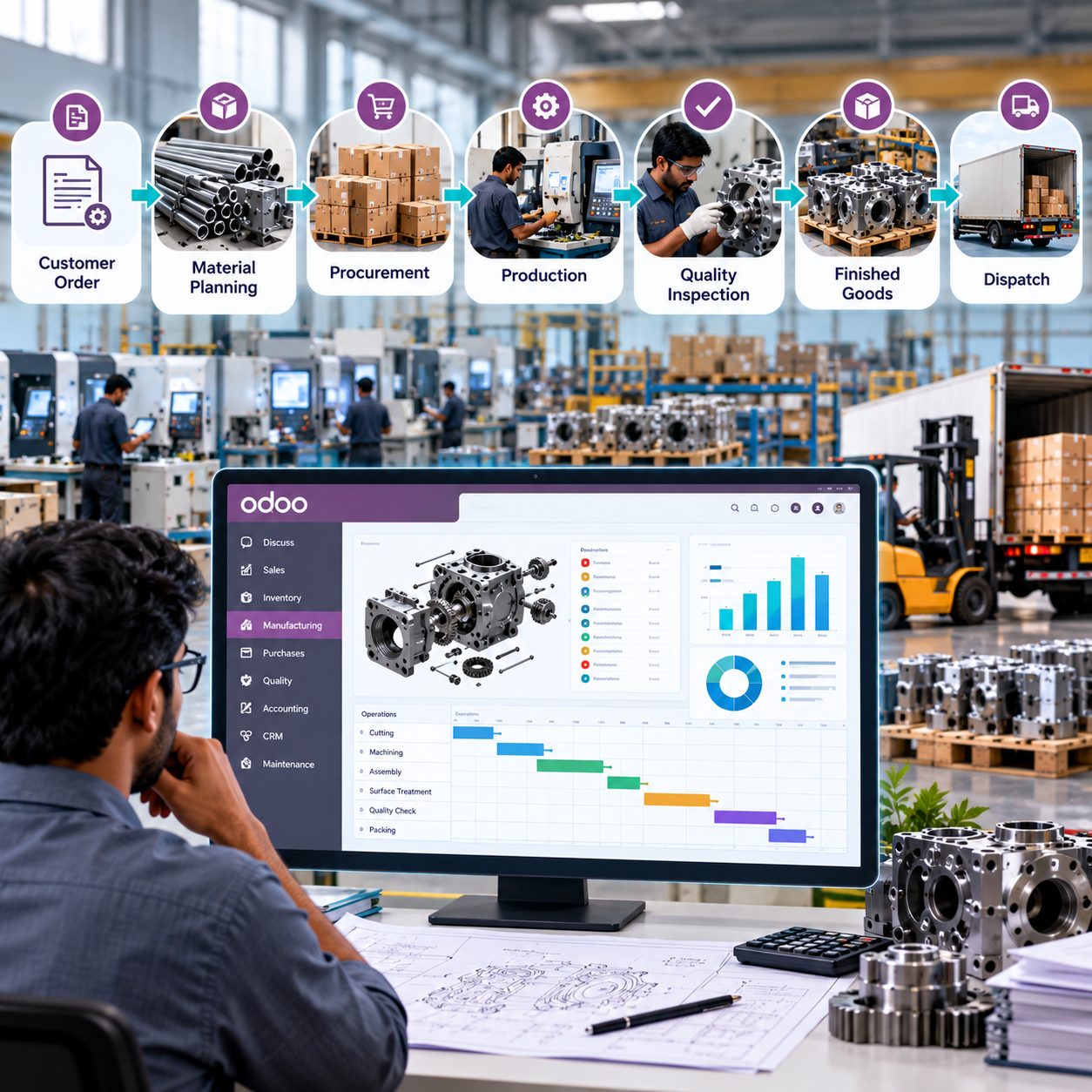
Customer order → Material planning → Procurement → Production → Quality inspection → Finished goods → Dispatch
Odoo can support this workflow through connected applications. The manufacturing team works with production orders and operations, while inventory records stock movements and purchasing handles material procurement.
The usefulness of this connection becomes clearer when an order changes.
Suppose the customer increases the requirement from 40 machines to 50. The business must review additional material requirements, procurement commitments, and production capacity. Odoo’s BOM and forecasting capabilities can help evaluate component availability, while scheduling and work-order dependencies support production planning where configured.
However, an ERP should not be treated as an automatic decision-maker. The accuracy of its output depends on the BOM, stock records, lead times, capacity settings, and other planning assumptions.
Odoo deserves closer evaluation for manufacturers looking for a broad application ecosystem, connected departmental workflows, and flexibility to extend processes as their business grows.
What Is ERPNext Manufacturing, and How Does It Work?
ERPNext is an integrated business management platform with manufacturing features covering BOMs, work orders, production plans, workstations, Job Cards, stock movements, and subcontracting. Its manufacturing workflow connects production execution with material tracking and other business functions.
Consider a component manufacturer producing several types of industrial fittings.
The production planner creates a work order for the required quantity. The BOM identifies the materials and operations. Workstations represent where operations take place, while Job Cards record progress against individual operations.
Material movements can then be recorded between stores, work in progress, and finished-goods locations.
This structure helps answer practical questions: How much has been completed? Which operation is pending? What material has been transferred to production? How much operation time has been recorded?
ERPNext’s Work Order documentation also describes planned and actual operation costs, with actual operating information updated through Job Cards. This can be useful when a manufacturer wants to compare planned production effort with recorded performance.
But there is an important consideration.
You must determine whether the normal workflow is enough or if more setup and development are required if your factory has a highly customized routing procedure, uses complex approval rules, or needs specialized production reports.
Manufacturers whose needs align with their manufacturing workflow and who seek an integrated platform with an open-source base and custom development choices are the ones for whom ERPNext merits a closer examination.
Odoo vs ERPNext: A Practical Manufacturing Comparison
Odoo and ERPNext both support core manufacturing operations, but their suitability depends on the way you structure production, track work, and connect other departments. A useful comparison should examine how each system supports your required workflow and what additional configuration is necessary.
| Manufacturing requirement | Odoo | ERPNext |
| Multi-level BOMs | Supported, including product variants | Supported, including sub-assemblies |
| Production execution | Manufacturing orders and work orders | Work Orders |
| Operation-level tracking | Work centres and work orders | Workstations and Job Cards |
| Production planning | Scheduling, replenishment and planning tools | Production Plans and material requirements |
| Quality management | Dedicated Quality application | Quality Inspection and related workflows |
| Subcontracting | Supported through subcontracting workflows | Supported through subcontracting workflows |
| Scrap and production exceptions | Supports scrap, backorders and other manufacturing workflows | Supports material and production tracking; exact exception handling depends on configuration |
| Cost visibility | Manufacturing and work-in-progress costing capabilities | Material and operation costing capabilities |
| Connected business applications | Manufacturing, inventory, sales, purchasing, accounting and more | Manufacturing, stock, sales, purchasing, accounting and more |
| Custom development | Custom modules and development options | Custom applications and development options |
Feature availability, workflow behaviour and implementation effort vary by version, edition and configuration. Verify the exact requirements against the version being proposed.
The table shows that both products cover substantial manufacturing functionality. It does not establish that one system is automatically better for every production model.
For example, a manufacturer may prioritise operation-level tracking, while another may need detailed coordination between engineering changes, purchasing, and customer commitments.
The correct evaluation starts with those priorities.
Not Sure Whether Odoo or ERPNext Fits Your Factory?
Compare both ERP systems against your production workflow, material planning, job work, and costing requirements before making a decision.
Real-World Manufacturing Scenarios: Odoo vs ERPNext in Action
Scenario 1: What Happens When Your BOM Changes Midway?
A BOM change can affect material requirements, purchase orders, sub-assemblies, and production costs. The ERP must help your team distinguish the old product specification from the revised requirement and determine which open orders need attention.
Suppose your engineering team changes the shaft specification for a pump assembly.
Some production orders are not yet started. Others have completed machining, and a few shafts are already with an outside processor.
Simply editing the BOM without considering open work can create confusion. The business needs to establish which revision applies to each order, what material is already consumed, and whether completed work can still be used.
Odoo supports BOMs, product variants, and manufacturing workflows that can be configured around production requirements. ERPNext supports multi-level BOMs and work orders that reference the relevant manufacturing structure.
However, engineering revision control must be evaluated separately from basic BOM availability. Depending on the process, the implementation may need document control, approval workflows, revision references, or additional development.
Ask both implementation partners to demonstrate the same change:
- A component specification changes.
- Some production orders are open.
- Material has already been issued for one order.
- The purchase team has placed an order for the old component.
- Management needs to identify affected orders and take corrective action.
The deciding factor is not who edits the BOM faster. It is who can help you control the consequences of the change.
Scenario 2: When Job Work Creates a Production Bottleneck
Subcontracting becomes difficult when materials leave your factory but remain your responsibility. Your ERP should help track what was sent, what was processed, what came back, and what is still pending, while preserving the connection to the original production requirement.
Consider a Rajkot-based engineering manufacturer that sends 500 machined components for heat treatment.
The vendor returns 350 components. Of these, 20 fail inspection, and 130 remain pending.
The production manager needs to know whether assembly can begin, which customer orders may be delayed, and whether another batch should be sent to the vendor.
Both Odoo and ERPNext provide subcontracting functionality. The specific workflow should be tested against your material ownership, vendor processing, receipt, and reconciliation requirements.
During the demonstration, ask the partner to show:
- Material dispatched to the subcontractor.
- Quantity returned against the original requirement.
- Rejected and pending quantities.
- Processing charges and supplier billing.
- Impact on production readiness and delivery commitments.
If the team still needs an independent spreadsheet to determine where every component is, the process needs further attention.
Scenario 3: Why Available Stock Does Not Always Mean Usable Stock
Inventory availability must be calculated in the context of actual demand and material status. Stock may be reserved for another order, awaiting inspection, or unsuitable for the next operation, even when the warehouse balance appears sufficient.
Suppose your inventory report shows 1,000 bearings.
At first glance, that looks comfortable. But 700 are required for confirmed production orders, 100 are awaiting quality clearance, and 100 are reserved for another requirement.
The quantity available for a new order may therefore be much lower than the physical balance suggests.
A useful manufacturing ERP implementation must distinguish physical stock, reserved stock, stock under inspection, and material available for use. It should also help planners review expected receipts and procurement requirements.
Odoo and ERPNext both connect manufacturing with inventory and material planning. The exact availability calculation and planning workflow depend on reservations, warehouse configuration, stock status, and other settings.
Ask the partner to demonstrate a material shortage in the middle of a production schedule. Then check whether the system helps identify the affected orders, required quantity, and expected replenishment.
The real objective is to avoid discovering a shortage only after the machine operator is waiting for material.
Scenario 4: Why Your Production Cost Is Different From the Quotation
Production costing becomes useful when planned costs can be compared with actual material consumption, operation time, scrap, and outside processing. An ERP can provide the underlying information, but accurate results depend on how the business records these activities and allocates costs.
Imagine quoting ₹10,000 for a manufactured component.
The planned cost is based on raw material, machining time, labour, and surface treatment. During production, the team consumes additional material, a batch requires rework, and the subcontractor charges more than expected.
The original quotation may still be correct as a commercial document, but it no longer represents the actual cost of completing the order.
Your ERP should help investigate the difference.
For Odoo, evaluate the available manufacturing and work-in-progress costing features and the reports required by your business. For ERPNext, review its planned and actual operating cost information and the treatment of additional manufacturing expenses.
The important questions are:
- Was more material consumed than planned?
- Did the operation take longer than expected?
- Was scrap recorded correctly?
- Were outside processing charges included?
- Can the team compare cost differences across production orders?
This is where manufacturing ERP becomes a management tool rather than a transaction-recording system.
A cost report cannot explain a variance if the factory never recorded the additional material, machine time, or rework in the first place.
Scenario 5: Quality Rejection Should Trigger an Action, Not Just a Record
Quality management becomes effective when an inspection result leads to a defined next step. The process must identify rejected material, control its movement, and help the responsible team decide whether it should be reworked, returned, scrapped, or released after approval.
Let's say 200 parts pass the machining process, but 15 don't pass the dimensional check.
Recording a rejection is only the first step. The factory must also decide whether the remaining 185 can proceed, how the rejected components will be handled, and whether the failure affects other batches.
Odoo’s Quality application supports quality checks and quality alerts. ERPNext allows manufacturers to record inspection results and incorporate quality checks into their production processes.
For both platforms, evaluate the complete process:
- Record the inspection result and rejection reason.
- Identify and separate the affected quantity.
- Assign responsibility for investigation or corrective action.
- Record rework, replacement, or scrap where applicable.
- Update production readiness and relevant stock records.
The implementation must also define who can approve exceptions. A rejected batch should not return to usable stock merely because someone changes a status without following the required approval process.
Cost, Customisation and Scalability: What Should You Compare?
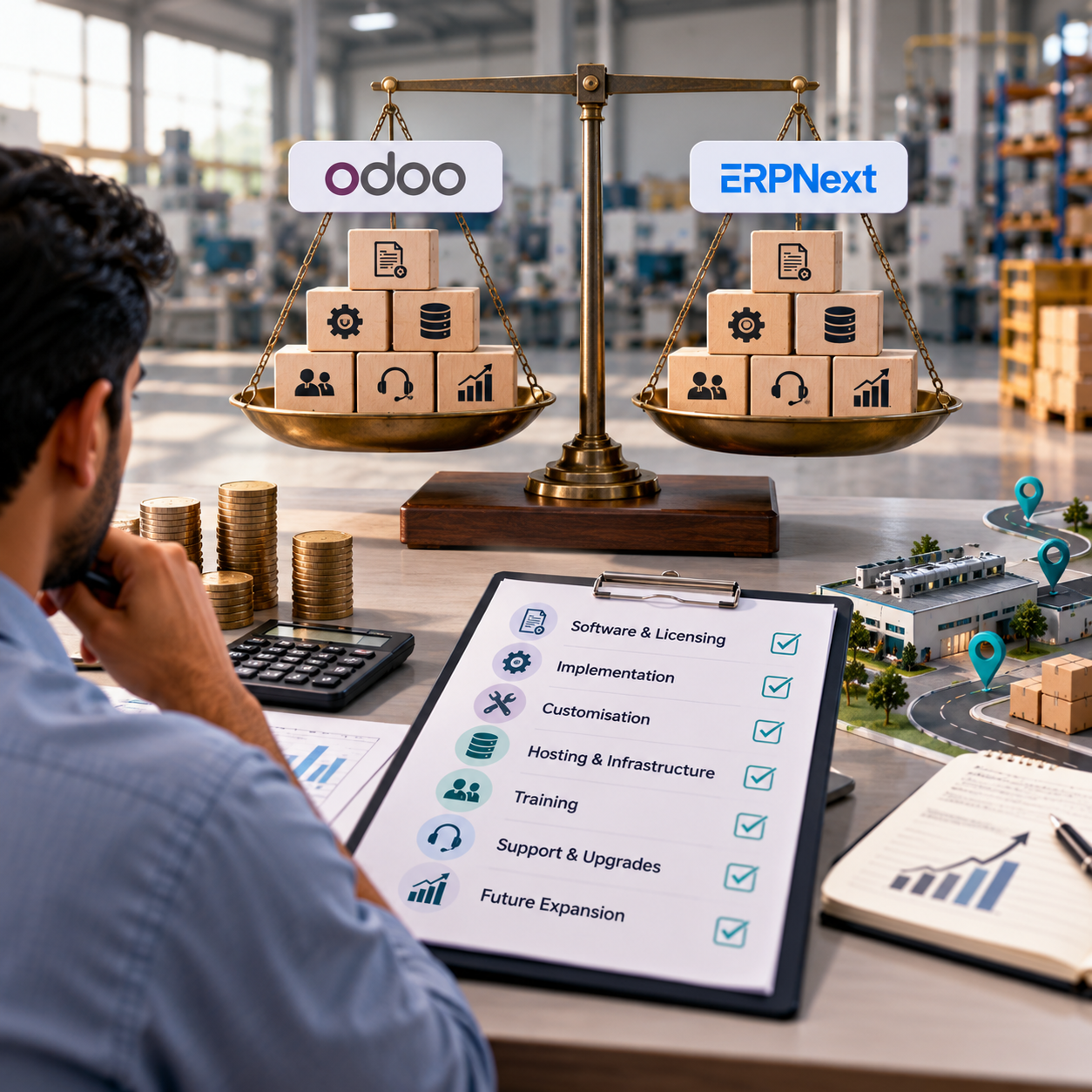
The cost of a manufacturing ERP goes beyond software licensing. Implementation, data migration, custom development, infrastructure, training, support, and future upgrades can materially affect the investment over the life of the system.Odoo and ERPNext differ in licensing and deployment, so compare their total costs before deciding.
| Cost factor | Questions to ask |
| Software and licensing | Which edition, applications and user licences are included? |
| Implementation | Does the proposal include process mapping and testing? |
| Customisation | Which requirements need development rather than configuration? |
| Hosting and infrastructure | What are the recurring costs, backup arrangements and security responsibilities? |
| Training | Will operators, supervisors and managers receive role-specific training? |
| Support and upgrades | What is included, and how will customisations be maintained? |
| Future expansion | What additional effort will be needed for new plants, workflows or product lines? |
Open-source software is not always cheaper to implement. Development still requires skilled people, testing, and ongoing maintenance.
Similarly, a commercial application ecosystem does not automatically make Odoo more expensive or more suitable. The final cost varies with the edition, applications, hosting setup, and implementation requirements.
For a fair comparison, ask both partners to quote the same requirements and identify every assumption.
Indian Compliance and Local Manufacturing Requirements
An ERP implementation in India should account for the business’s applicable statutory requirements alongside production needs. GST invoicing, e-invoicing, e-way bills, inventory records and financial reporting should be evaluated against the company’s actual transactions, registrations and regulatory obligations.
For official information about India’s MSME framework and support programmes, consult the Ministry of Micro, Small and Medium Enterprises.
During evaluation, ask the implementation partner to confirm:
- Required GST and invoicing workflows.
- Applicable e-invoicing and e-way bill integrations.
- Vendor billing and subcontracting documentation.
- Inventory valuation and financial reporting requirements.
- Batch or serial-number traceability, where relevant.
- Required statutory reports and the responsibility for maintaining integrations.
Do not assume that every requirement is automatically covered because the software supports accounting or has an Indian localisation. Confirm the version, configuration, integration dependencies, and compliance responsibilities before implementation.
Local manufacturing knowledge is equally important. A partner should understand the practical difference between production planning, job work, rework, and inventory reconciliation—not merely how to configure software fields.
Illustrative Case Study: From Production Confusion to a Controlled Workflow
Problem
An engineering company builds made-to-order assemblies using bought-out parts, in-house machining and external finishing services.
Production updates are collected through spreadsheets and phone calls. Managers cannot quickly distinguish orders waiting for material from those waiting for subcontracting or inspection.
The company needs better visibility without creating additional paperwork for operators.
Workflow
The team maps the production journey:
Customer order → BOM → Material planning → Purchasing → Machining → Subcontracting → Quality inspection → Assembly → Dispatch
Each operation receives a clear owner, defined completion criteria, and a procedure for recording shortages, rejection, and rework.
Intervention
The implementation team evaluates Odoo and ERPNext against the mapped process, then configures the selected system to support the required workflow.
The work includes:
- Reviewing BOM accuracy and material masters.
- Defining production operations and responsibilities.
- Connecting material movements with production orders.
- Establishing subcontracting and quality procedures.
- Defining reports for pending work, shortages, and production costs.
- Training employees to enter data at the right stage of production.
Result
The intended result is a more reliable view of production progress, outstanding vendor work, and material availability. Managers can investigate delays using recorded operational information rather than relying entirely on verbal updates.
The business should measure the outcome using baseline and follow-up data, such as order completion time, material variance, rework cost, and on-time delivery. Without those measurements, a percentage improvement should not be claimed.
ERP implementation is not just software installation. It is the process of making business workflows visible, repeatable, and measurable.
How to Choose Between Odoo and ERPNext for Your Factory
The best ERP for manufacturing companies in India is the one that supports your actual production model with reliable controls, manageable operating costs, and a practical implementation plan. The decision should be based on demonstrated workflows rather than brand popularity or a feature checklist.
Use this evaluation framework:
Choose Odoo for closer evaluation if:
- You want manufacturing connected to a broad application ecosystem.
- Your business requires workflows spanning sales, purchasing, inventory, quality, and accounting.
- Your planned operations can be supported by its standard capabilities and justified extensions.
Choose ERPNext for closer evaluation if:
- Its standard manufacturing workflow aligns with your operations.
- You value its open-source foundation and custom development options.
- Your team and implementation partner can support the required configuration and ongoing maintenance.
Neither list is exclusive. Both platforms can support connected business processes, and either may require additional work for specialised manufacturing requirements.
Before making a decision, run a practical demonstration using one real production order. Include a BOM change, material shortage, delayed subcontractor, quality rejection, and cost variance.
Then compare the results on five criteria:
- Workflow coverage.
- Manual data entry and duplicate work.
- Traceability and reporting.
- Customisation and upgrade implications.
- Total implementation and operating cost.
This process gives you a much stronger basis for choosing than a generic claim that one ERP is better for every manufacturer.
Conclusion: Don’t Choose an ERP Until You Test a Difficult Production Order
The real Odoo vs ERPNext decision is not about which software looks better during a demonstration. It is about how reliably your business can plan production, control materials, manage exceptions, and understand manufacturing costs when conditions change.
Both platforms offer meaningful manufacturing capabilities. The right choice depends on your workflows, the quality of your data, your team’s ability to use the system, and the expertise of the implementation partner.
At Teknovative Solution, our approach is to understand the business workflow first, develop practical SOPs, digitise the processes through ERP, train the team, and support continuous improvement.
Before committing to either platform, map one difficult production order from customer confirmation to final dispatch. Include every material movement, operation, quality decision, and subcontracting step.
Then ask both implementation partners to demonstrate that exact workflow.
Your factory does not need an ERP that simply records production. It needs a system that helps your team understand and control production.
That is the standard worth using to make your decision.
Read Also: Can AI Connect Sales, Inventory, Production, and Accounting in Manufacturing?
Planning ERP Implementation for Your Manufacturing Business?
Identify workflow gaps, production bottlenecks, and implementation priorities with guidance tailored to your business requirements.
Frequently Asked Questions
Neither is universally better. Odoo may be a strong fit for businesses seeking a broad application ecosystem, while ERPNext may suit manufacturers whose requirements align with its standard workflows. Test both against your production scenarios.
The best ERP is the one that manages your BOMs, production operations, material availability, quality, purchasing, and costing accurately. Implementation quality and user adoption matter as much as software features.
Yes. Odoo supports multi-level BOMs, work centres, work-order dependencies, manufacturing orders, scrap tracking, subcontracting, and production reporting. The suitability of a specific implementation depends on configuration, edition, and additional requirements.
ERPNext supports BOMs, Work Orders, Job Cards, workstations, production planning, and inventory integration. Complex or specialised workflows may require additional configuration or development, which should be established during evaluation.
There is no universal answer. Compare licensing, hosting, implementation, customisation, training, support, and upgrade costs over the expected period of use.
Yes. Both provide subcontracting functionality. Verify material dispatch, quantities returned, pending work, rejected material, vendor charges, and reconciliation against your specific requirements.
Both provide manufacturing costing capabilities. The accuracy and detail of actual costs depend on how materials, operations, scrap, rework, and additional expenses are recorded and configured.
The timeline depends on production complexity, data quality, integrations, number of locations, customisation, and user readiness. A clear scope and accurate process mapping are essential for a realistic estimate.
Open-source software can offer flexibility and control, but the business must still account for implementation, hosting, development, maintenance, and support. Compare the total cost and operational fit before deciding.