
Owner dependency in manufacturing happens when important decisions, approvals, customer commitments, production fixes, and even routine purchases still need the owner’s personal involvement. Although it seems like control, it eventually turns into a bottleneck. The factory may have machines, managers, and software, yet the owner remains the real operating system.
If you run a factory in India, you may recognise the pattern.
A production manager calls you because a machine has stopped.
Purchase calls because a supplier changed the delivery date.
Sales calls because a customer wants an earlier dispatch.
Accounts calls because someone needs payment approval.
And before you know it, your morning plan has disappeared.
This is common in Indian manufacturing businesses, especially when the owner has built the company from the ground up. Your workers' incapacity is not the issue. The problem is that the business has learned to depend on your memory, judgement, and relationships instead of repeatable systems.
That is the real meaning of an owner-dependent manufacturing business.
What Is Owner Dependency in Manufacturing?
Owner dependency in manufacturing means the factory cannot consistently make decisions or complete important processes without the owner’s direct involvement. The business may continue when the owner is present, but performance slows, decisions pile up, and mistakes increase when the owner steps away.
A simple test is this:
If you cannot take five working days away from the factory without receiving dozens of calls, your business probably has an owner-dependency problem.
Look at these situations:
| Factory Activity | High Owner Dependency | System-Driven Business |
| Production planning | Owner decides priorities | Planner follows defined rules |
| Purchase | Owner approves routine buying | Approval limits are defined |
| Quality | Owner resolves repeated issues | SOPs and quality checks guide action |
| Inventory | Owner knows what is available | Stock data is visible and reliable |
| Customer commitments | Owner confirms dates | Capacity and planning drive promises |
| Pricing | Owner calculates every quote | Standard costing supports decisions |
| Payments | Every payment comes to owner | Delegated approval matrix |
| Maintenance | Breakdown triggers owner calls | Preventive maintenance system |
The difference is not simply hard work versus less work.
It is personal knowledge versus organisational knowledge.
Why do Indian Factories Become Owner-Dependent?
Indian manufacturing often grows through relationships, practical knowledge, and quick decisions. That flexibility is a strength in the early years. But the same strength can become expensive when the factory gets bigger.
The owner knows which supplier gives better material.
He knows which customer usually pays late.
He knows which machine operator can handle a difficult job.
He remembers which product requires extra processing.
He knows which customer can be promised a two-day dispatch.
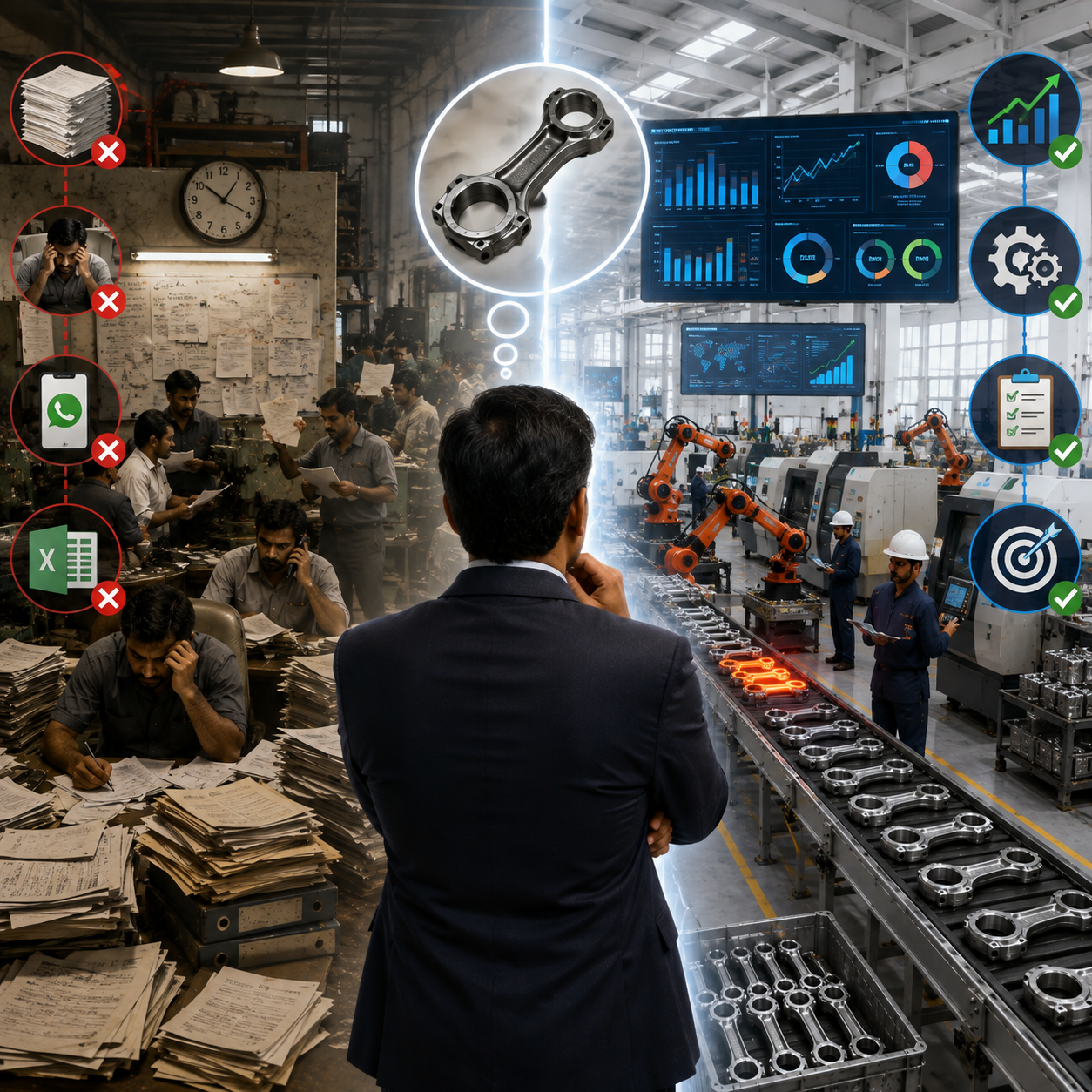
But most of that knowledge may exist only in his head, in WhatsApp chats, in phone calls, and in years of experience.
That creates four hidden costs:
- Decision delays when the owner is unavailable
- Repeated mistakes because lessons are not documented
- Management overload because every issue escalates upwards
- Growth limitations because the owner becomes the factory’s bottleneck
The Ministry of MSME’s current LEAN programme specifically focuses on improving productivity, efficiency and competitiveness through areas such as waste reduction, inventory management, space utilisation and energy consumption.
That principle applies here too: a factory becomes stronger when good decisions become part of the process rather than remaining inside one person’s head.
How Do You Know Your Factory Depends Too Much on You?
The easiest way to identify owner dependency is to track the decisions that repeatedly reach your desk. You do not need a consultant or complicated software to start. For one week, record every call, message, and approval that requires your intervention.
Create four columns:
Decision → Why it came to you → Who should handle it → What system is missing
You may discover patterns such as:
- People lack authority.
Managers are responsible for results but cannot make basic decisions. - Processes are unclear.
Everyone knows what to do, but nobody has clearly defined how to do it. - Information is scattered.
Production data sits in Excel, inventory in another file, and customer commitments on WhatsApp. - Rules exist only verbally.
“We normally purchase this way” is not a process. - The owner keeps solving symptoms.
A delayed order gets fixed today, but the reason behind the delay is never removed.
A useful question
If a new plant manager joined tomorrow, could you explain your entire operating method without personally training them for six months?
If the answer is no, your factory has a system problem not simply a people problem.
How to Reduce Owner Dependency in a Manufacturing Business
Reducing owner dependency does not mean suddenly handing everything to employees. It means moving decisions from people’s memory into defined processes, responsibilities, and information systems.
Start with the decisions that happen most frequently.
1. Standardise repeatable work:
Document the important processes:
- Production planning
- Material requisition
- Purchase approval
- Incoming quality inspection
- Job work
- Machine setup
- Rework handling
- Dispatch
- Customer complaint handling
- Payment approval
A good SOP should answer three things:
Who does it? What do they do? When do they escalate?
Do not create a 40-page document nobody reads. A one-page practical SOP is often more useful.
2. Define decision limits:
Your production manager should not call you for every small production decision.
Create approval limits.
For example:
| Decision | Team Can Decide | Owner Involvement |
| Routine material purchase | Within approved limit | Above limit |
| Production rescheduling | Within capacity rules | Major customer impact |
| Minor rework | Within defined tolerance | Repeated/major issue |
| Supplier selection | Approved vendor list | New strategic supplier |
| Customer dispatch change | Within agreed rules | Major commercial impact |
The goal is simple:
Escalate exceptions, not routine work.
3. Build one source of truth:
When production, inventory, purchase, and accounts work from different numbers, the owner becomes the human data-integrator.
That is dangerous.
Your team should be able to answer:
- What is currently in stock?
- What is committed?
- What is under production?
- Which orders are delayed?
- What material is pending?
- Which machines are unavailable?
- What is the actual production cost?
Without calling you.
Where Manufacturing ERP Software Can Help?
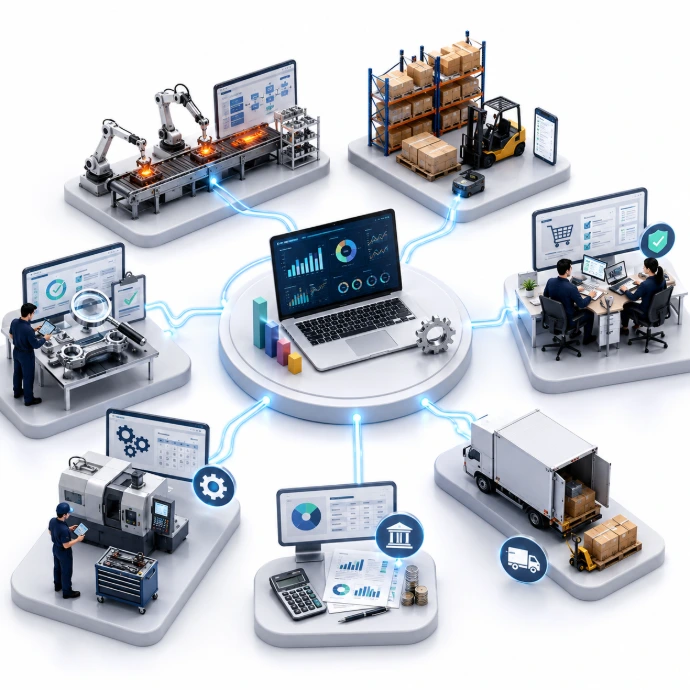
Manufacturing ERP software can reduce owner dependency when it turns important business knowledge into a shared, controlled workflow. But ERP should come after process clarity not before it.
This is where a platform such as Odoo ERP software can fit without becoming the centre of the transformation.
For a manufacturing business, useful Odoo areas include:
- Manufacturing (MRP): manufacturing orders, work orders, work centres, bills of materials and production planning
- Inventory: stock movements, locations, replenishment and traceability
- Purchase: supplier orders, vendor pricing and approval workflows
- Quality: quality checks and control points linked to operations
- Maintenance: preventive maintenance schedules and equipment records
- Accounting: customer/vendor transactions, payments and financial visibility
The feature list is not the crucial component.
It is the connection between them.
For example, a production requirement can create a material need; purchasing can act on that requirement; inventory can show availability; manufacturing can consume the material; and accounting can reflect the financial transaction.
That reduces the number of questions that have to travel through the owner’s phone.
The ERP with the biggest feature list is not the best one. It is the one your people can actually use to run the process without calling the owner.
How to Build a Factory That Runs Without the Owner
A factory becomes less owner-dependent when responsibility moves through three stages: knowledge → process → accountability.
Think about a typical production problem.
Old model
Machine stops → supervisor calls owner → owner calls maintenance → owner asks production about order priority → owner decides what should happen.
The owner has become the communication network.
Better model
Machine stops → breakdown recorded → maintenance team receives task → production plan is updated → priority rule determines next job → manager handles escalation only if a defined threshold is crossed.
Same factory.
Same machine.
Very different dependency.
This is why manufacturing process standardization matters so much.
You are not trying to remove human judgement. You are trying to reserve human judgement for situations where it actually adds value.
What Should the Owner Still Control?
Reducing owner dependency does not mean the owner should disappear from the business. It means the owner’s time should move towards decisions that actually require ownership.
You should increasingly spend time on:
- Capacity expansion
- Major customer relationships
- New product development
- Strategic suppliers
- Capital investment
- Leadership development
- Cash-flow strategy
- Market positioning
- Long-term profitability
You should spend less time on:
- Routine purchase approvals
- Daily production chasing
- Finding stock
- Checking individual dispatches
- Solving repeated quality problems
- Answering routine employee questions
- Following up on every pending payment
A useful rule is:
If the same question reaches you three times, don’t answer it a fourth time. Build the rule.
That one habit can change how an owner spends the next five years.
What Does a Stronger Manufacturing Business Look Like?
A strong manufacturing business does not depend on one person’s memory to maintain consistency. It has clear responsibilities, documented processes, reliable information, and managers who are trusted to make decisions within defined boundaries.
This also improves cost control.
When production is planned properly, inventory is visible, rework is tracked, and purchasing follows defined rules, cost leakage becomes easier to identify before it reaches the bottom line.
That is closely aligned with the Government of India’s current focus on LEAN manufacturing, which includes reducing waste and improving inventory and resource utilisation.
For an Indian manufacturer, this is a practical shift:
From Owner-Driven Decisions → to Process-Driven Operations
And that is one of the most important changes you can make if you want the factory to grow beyond your personal capacity.
Read Also: How to Grow Your Manufacturing Business in India: 15 Proven Strategies That Work
Conclusion
Your factory should benefit from your experience not depend on your constant presence.
As your business grows, turn your knowledge into clear processes, defined responsibilities, reliable data, and empowered managers.
The real sign of a mature factory is simple:
The business keeps running well even when you are not in the room.
At Teknovative Consultation, we believe the same principle applies to ERP: fix the process first, then use technology to support it.
Rapid Assistance Zone
Owner dependency occurs when routine factory decisions and operations require the owner’s direct involvement. It usually happens because processes, authority, responsibilities, and business information are not sufficiently standardised.
Start by identifying repeated owner interventions, documenting critical SOPs, delegating decision authority, defining escalation rules, and creating reliable access to production, inventory, purchase, and financial information.
A manufacturing business can operate without daily owner involvement when responsibilities are clearly assigned, processes are standardised, managers have decision-making authority, and operational information is available without depending on the owner’s personal knowledge.
Yes. ERP can reduce owner dependency by centralising operational information and automating defined workflows. However, ERP cannot replace unclear processes or weak management structures.
Odoo can be suitable for manufacturing SMEs that need connected manufacturing, inventory, purchase, quality, maintenance, and accounting workflows. The suitability depends on the factory’s processes, complexity, and implementation approach.
Neither is universally better. Odoo can be attractive when flexibility, modularity, and broad business applications matter, while SAP Business One can suit businesses looking for a more established, structured ERP environment. The decision should follow business requirements, not software popularity.
Manufacturing process standardization means defining a consistent method for performing repeatable activities, including responsibilities, inputs, outputs, quality checks, decision rules, and escalation conditions.