
If you are planning to implement Odoo ERP in your business, one of the first questions you will probably ask is:
How much does Odoo cost in India?
The short answer is: there is no single Odoo price for every business.
For a typical Indian business, an Odoo implementation can range from around ₹2 lakh to ₹25 lakh+, depending on the project's size and complexity. Simple implementations may fall toward the lower end, while manufacturing, multi-location, multi-company, and highly customized implementations can move significantly higher.
Current 2026- 27 India-focused implementation guides show similarly wide ranges, with small implementations around ₹1.5–4 lakh, mid-market projects around ₹4–15 lakh, and complex manufacturing or multi-entity implementations reaching ₹15–40 lakh or more. Other market guides report narrower or lower ranges because they define implementation scope differently.
So the more useful question is not:
“What is the price of Odoo?”
It is:
"How much will Odoo cost based on my business's requirements and the scope of implementation?"
This guide breaks down the major Odoo ERP cost components, realistic implementation ranges in India, manufacturing-specific costs, customization, data migration, integrations, and the factors that can make one Odoo project cost ₹3 lakh while another costs ₹20 lakh or more.
Odoo ERP Cost in India at a Glance
For initial budgeting, these are useful indicative implementation ranges for the Indian market:
| Odoo Project Type | Indicative Implementation Cost |
| Basic / Standard Implementation | ₹2–5 lakh |
| Small Business / SME Implementation | ₹3–7 lakh |
| Mid-size / Multi-Department Implementation | ₹6–12 lakh |
| Manufacturing ERP Implementation | ₹8–20 lakh+ |
| Complex / Highly Customized Implementation | ₹15–25 lakh+ |
| Multi-Company / Multi-Location / Complex Enterprise Rollout | ₹20 lakh+ |
These are not fixed Odoo prices. They are budgeting ranges for implementation services. Actual project costs depend on the number of users, applications, business processes, customization, data migration, integrations, reporting, and implementation scope.
Different Indian implementation guides publish different ranges because a “basic implementation” can mean different things from one provider to another.
Odoo ERP Implementation: What Should Your Business Budget For?
Odoo ERP cost should not be viewed as a single invoice.
A practical Odoo budget can contain several components:
Odoo Subscription + Implementation + Customization + Data Migration + Integrations + Training + Support
The exact combination depends on your project.
For example, a business implementing standard Sales, Purchase, Inventory, and Accounting workflows may have a relatively straightforward implementation.
A manufacturing business may additionally require:
- Manufacturing
- Bills of Materials
- Work Orders
- Quality
- Maintenance
- Barcode
- Subcontracting
- Production planning
- Multiple warehouses
- Custom reports
- Machine or weighing-scale integration
- Legacy data migration
Naturally, the implementation effort can be much higher.
Odoo ERP in India: A Practical Guide to Implementation Costs
There is no official fixed implementation price because Odoo implementation is a project service rather than a single software product with one universal setup fee.
For budgeting, businesses can use the following ranges.
1. Basic Odoo Implementation: ₹2–5 Lakh
A relatively simple implementation may fall within this range when the business can use mostly standard Odoo functionality.
Typical scope may include:
- CRM
- Sales
- Purchase
- Inventory
- Invoicing
- Basic Accounting
- Standard reports
- User configuration
- Basic data migration
- User training
The actual cost can be lower or higher depending on scope.
2. Small Business / SME Implementation: ₹3–7 Lakh
A growing business may require multiple connected departments and more structured workflows.
For example:
CRM → Sales → Purchase → Inventory → Accounting
Additional requirements may include:
- Approval workflows
- Multiple warehouses
- Advanced reporting
- Customer/vendor migration
- Automated activities
- Custom documents
- Department-wise access
- Basic integrations
- Employee training
3. Mid-size / Multi-Department Implementation: ₹6–12 Lakh
As business processes become more interconnected, implementation effort generally increases.
A project may involve:
- CRM
- Sales
- Purchase
- Inventory
- Accounting
- Manufacturing
- Quality
- Maintenance
- HR
- Projects
- Helpdesk
- Advanced reporting
- Multiple locations
- Data migration
- Workflow automation
- Integrations
The important factor is not simply the number of modules.
It is how those modules need to work together.
4. Manufacturing ERP Implementation: ₹8–20 Lakh+
Manufacturing implementations can require significantly more process analysis and testing than straightforward trading or service implementations.
A manufacturing implementation may include:
- Manufacturing
- Bills of Materials
- Work Orders
- Work Centers
- Routings
- Production Planning
- Inventory
- Quality
- Maintenance
- PLM
- Barcode
- Subcontracting
- Lot/Serial Tracking
- Production costing
- Scrap management
- Custom production reports
Current India-focused 2026-27 guides commonly place complex manufacturing implementations in the higher cost bands, with published estimates reaching ₹12–20 lakh or more, and some broader market estimates going considerably higher for complex rollouts.
Not Sure What Your Odoo Budget Should Be?
Understand what your business actually needs before you invest in ERP.
Why Does One Odoo Project Cost ₹3 Lakh and Another ₹15 Lakh?
Because Odoo implementation is not priced only by the number of users.
Consider two companies with the same number of users.
Business A: Trading Company
15 users require:
- Sales
- Purchase
- Inventory
- Accounting
- Basic reporting
Most processes can use standard Odoo functionality.
Business B: Manufacturing Company
15 users require:
- Production planning
- Multiple BOMs
- Work Orders
- Quality inspections
- Machine maintenance
- Multiple warehouses
- Batch tracking
- Custom production reports
- Existing ERP data migration
- External integrations
Both businesses have 15 users.
But their implementation requirements differ completely.
That’s why the number of users alone doesn’t define the overall Odoo implementation cost.
What Factors Affect Odoo Implementation Cost?
1. Number of Users
The number of users mainly affects your recurring Odoo subscription cost, but it does not automatically determine the implementation effort.
A 10-user manufacturing business may need more implementation effort than a 30-user service company when its workflows involve greater complexity, configuration, or customization.
2. Number of Applications
The number of Odoo applications influences the implementation scope, but it is only one part of the overall effort. A company using CRM, Sales, and Inventory may have a relatively simple setup, while a manufacturer may need Manufacturing, Inventory, Purchase, Quality, Maintenance, PLM, Barcode, Accounting, and Sales.
What matters more is how these applications need to connect and function together across your business workflow.
3. Business Process Complexity
Business process complexity is often one of the biggest factors affecting Odoo implementation cost.
A standard process may follow Quotation → Sales Order → Delivery → Invoice, while a manufacturing workflow can involve material planning, purchase, quality checks, stores, production, finished goods, dispatch, and accounting.
When these stages include different approvals, calculations, quality checks, and reports, the implementation requires more effort.
4. Customization
Customization can significantly increase the total Odoo project cost when your business requires workflows or functionality beyond standard Odoo. This can include custom fields, approval workflows, reports, dashboards, automated calculations, documents, industry-specific processes, API integrations, or special production logic.
Customization should not always be the starting point. A practical approach is to understand the requirement → evaluate standard Odoo → configure where possible → customize only when necessary.
This approach helps keep implementation costs under control while reducing long-term maintenance effort.
5. Data Migration
Moving existing business data into Odoo can also affect implementation cost, especially when the data comes from Excel, Tally, a previous ERP, accounting software, CRM, or warehouse systems. Data such as customers, vendors, products, opening balances, stock, price lists, Bills of Materials, and outstanding invoices may need to be migrated.
If the existing data is incomplete, duplicated, or inconsistent, additional cleaning and preparation may be required before it can be imported into Odoo.
6. Third-Party Integrations
If Odoo needs to connect with external systems, additional development may be required, which can increase the project cost.
Common examples include payment gateways, eCommerce platforms, shipping systems, WhatsApp, Tally, banking systems, barcode systems, weighing machines, external APIs, and customer portals.
The cost can vary significantly because every integration has different technical requirements and levels of complexity.
7. Custom Reports and Dashboards
Custom reports and dashboards may increase implementation costs when standard Odoo reports do not provide the specific business insights or formats management requires.
Requirements may include sales profitability, inventory ageing, pending orders, production output, material consumption, scrap, machine downtime, purchase performance, customer outstanding, or department-wise performance.
Standard Odoo reports may cover many requirements, while more specific reporting needs can require additional customization or development.
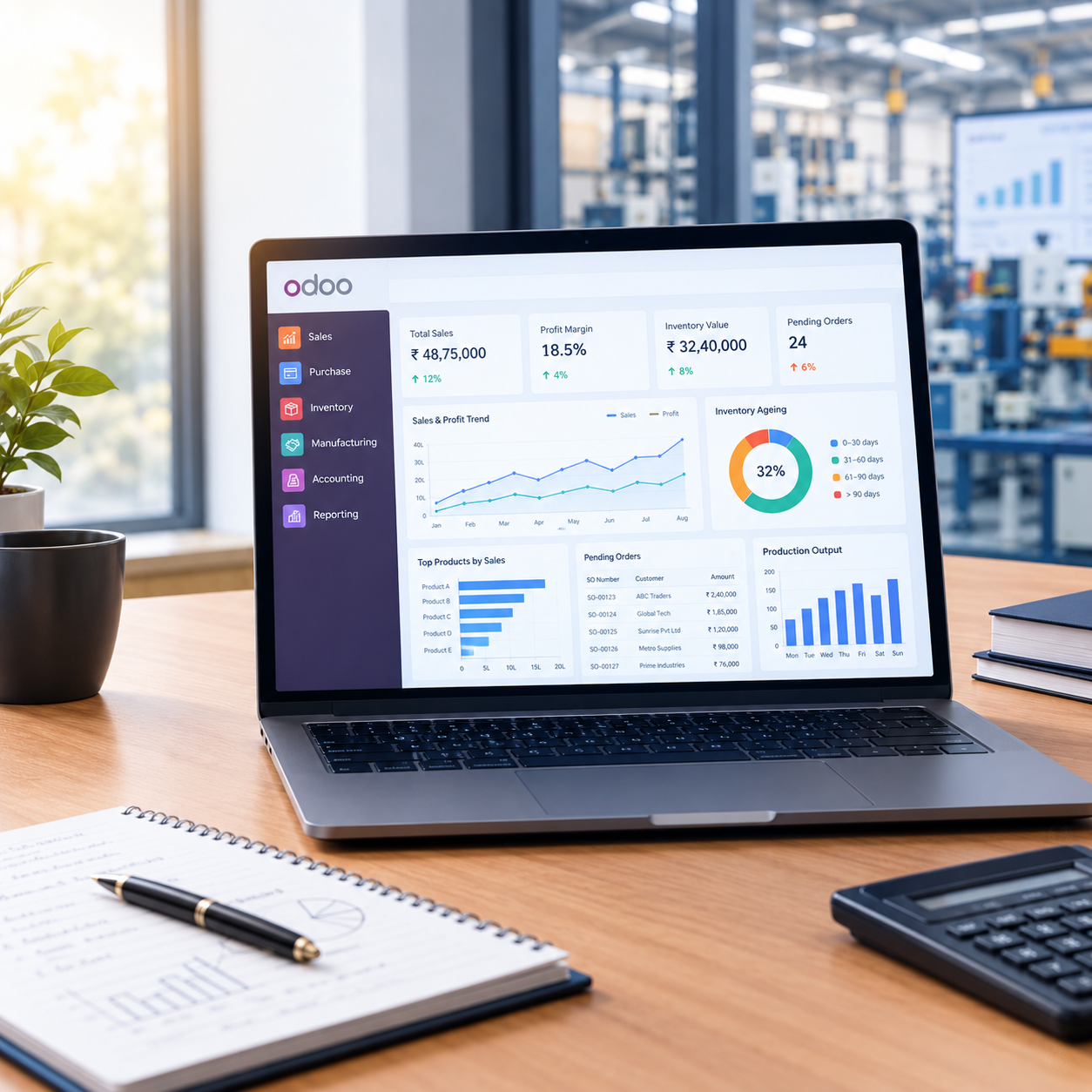
Odoo Subscription Cost vs Implementation Cost
The key point to understand is:
Odoo subscription cost and Odoo implementation cost are two different things.
The subscription is the recurring software cost.
Implementation is the work involved in configuring and adapting the ERP to fit your business processes.
Implementation may include:
- Business process analysis
- Requirement gathering
- Workflow mapping
- Configuration
- Customization
- Data migration
- Testing
- Training
- Go-live support
Odoo’s own implementation guidance describes activities such as business-needs analysis, configuration, training/coaching, data import, and customization of business flows.
For current subscription pricing, businesses should verify Odoo’s official pricing page because subscription rates and plan details can change.
Odoo Cost for Trading vs Manufacturing Businesses
The industry itself can significantly affect implementation complexity.
Trading Business
A typical workflow may be:
CRM → Sales → Purchase → Inventory → Accounting
If the processes are relatively standard, implementation can remain toward the lower end of the range.
Manufacturing Business
A typical workflow may be:
Sales → Planning → Procurement → Stores → Manufacturing → Quality → Maintenance → Finished Goods → Dispatch → Accounting
This introduces many more operational dependencies.
Therefore, two businesses with the same number of users can have completely different implementation budgets.
Can Odoo Pay for Its Own Investment?
Yes — but the answer is not in the software price. It is in the business improvement that follows.
For example, if a company invests ₹8 lakh in ERP and the improved processes create an average ₹75,000 monthly financial benefit, the simple payback calculation is:
₹8,00,000 ÷ ₹75,000 = ~11 months
After that point, the same operational improvements can continue creating value.
The actual payback period depends on the company's processes, implementation scope, and measurable savings. Published 2026 industry estimates also vary considerably, so there is no single payback period that applies to every Odoo project.
A Real Example: Creative Shadows
Creative Shadows Promotion Pvt. Ltd. manufactures customized automotive dealer kits, where every order can have different designs, components, and quantities.
Before ERP, production planning, procurement, and production tracking involved significant manual coordination.
After implementing Odoo across CRM, Sales, Purchase, Inventory, and Manufacturing, the business achieved:
- 100% automated production & purchase planning
- Real-time production visibility
- Better raw-material control
- More accurate production costing
- Less dependency on manual coordination
The important lesson is simple:
ERP cost is not the same as ERP value.
If Odoo helps a manufacturer reduce delays, control inventory, improve planning, and make better decisions, the investment can gradually pay for itself through measurable operational gains.
That is why we recommend calculating Odoo cost against the business problems it is expected to solve — not just the number on the quotation.
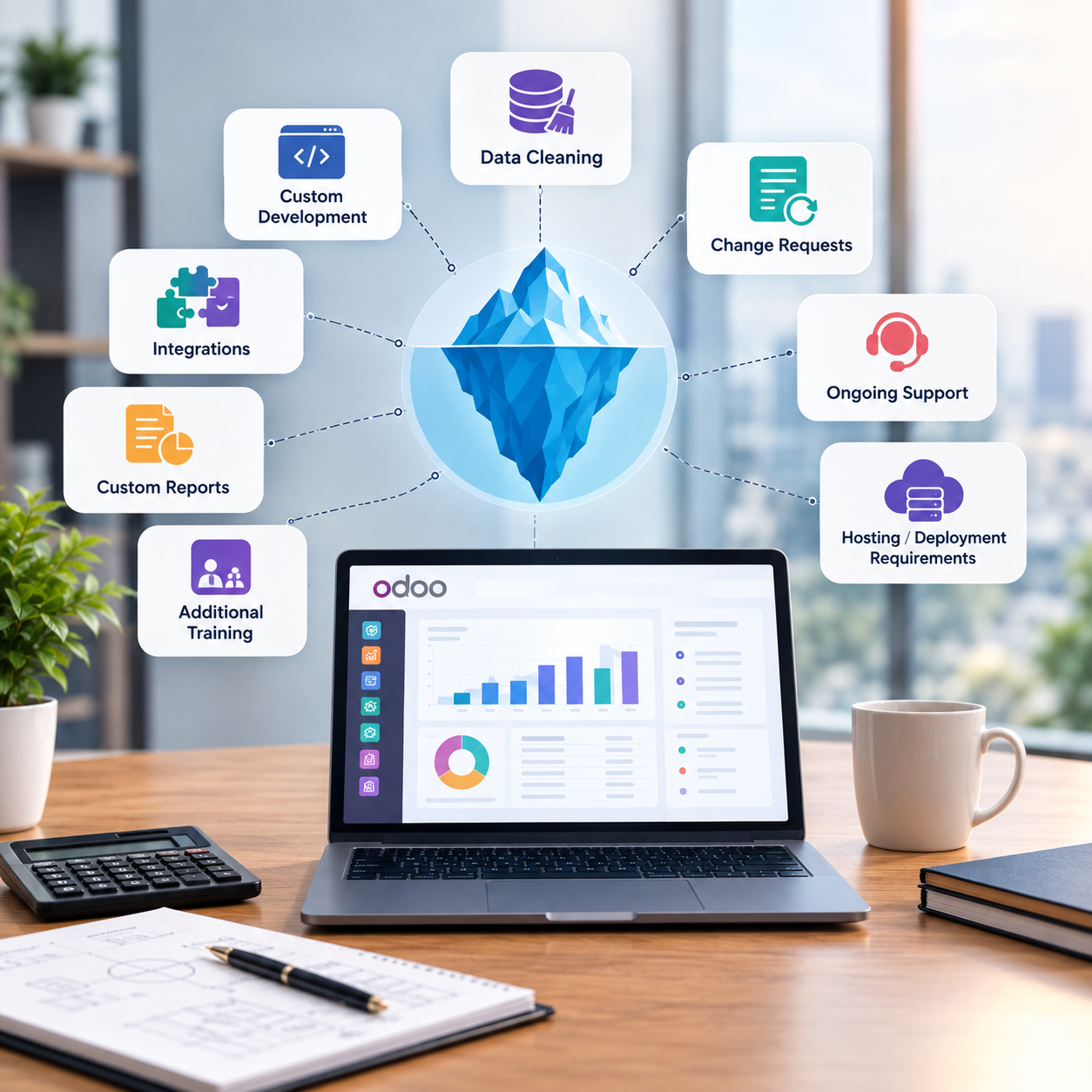
What Are the Hidden Costs of Odoo Implementation?
Not every additional cost is actually “hidden.”
Often, it simply wasn’t included in the original project scope.
Potential additional costs include:
Data Cleaning
Preparing existing records before migration.
Custom Development
Building workflows that standard Odoo functionality cannot reasonably handle.
Integrations
Connecting Odoo with external applications, machines, or platforms.
Custom Reports
Creating management reports beyond standard reporting.
Additional Training
Training additional departments, locations, or new employees.
Change Requests
Adding new requirements after the original scope has been finalized.
Ongoing Support
Post-go-live support, maintenance, and future enhancements may require a separate commercial arrangement.
Hosting / Deployment Requirements
Depending on the chosen Odoo deployment approach, hosting can be another component of the overall budget.
How to Calculate Your Odoo Budget?
Instead of asking only:
“How much is Odoo?”
Break your budget into these categories:
| Cost Area | What It Covers |
| Software Subscription | Recurring Odoo subscription |
| Implementation | Analysis, configuration, and deployment |
| Customization | Custom workflows, reports, and development |
| Data Migration | Cleaning and importing existing data |
| Integrations | Connecting external systems |
| Training | User and administrator training |
| Support | Post-go-live support and maintenance |
| Additional Requirements | Future enhancements and change requests |
This gives you a much more realistic view of the total ERP investment.
How to Compare Two Odoo Implementation Quotes
Suppose you receive:
Quote A: ₹4 lakh
Quote B: ₹9 lakh
Don’t immediately assume the ₹4 lakh quote is cheaper.
First, compare what is included.
Requirements:
Business process analysis, Odoo configuration, Data migration, Customization, Custom reports, Integrations, Testing, Training, Go-live support, and Post-go-live support.
A lower quotation may simply have a smaller scope.
A higher quotation may include more implementation work.
Therefore:
Don’t compare only the final number. Compare the deliverables behind the number.
Does a Higher Odoo Implementation Cost Mean a Better ERP?
Not necessarily.
A project can become expensive because of unnecessary customization.
At the same time, choosing an implementation only because it has the lowest quotation can create additional costs if the scope excludes important requirements.
The objective should be:
The right implementation scope for your business.
If standard Odoo can solve a requirement, customization may not be necessary.
If your business genuinely requires functionality that standard Odoo cannot reasonably provide, customization may be justified.
The goal is not to make Odoo as customized as possible.
The goal is to make Odoo fit the business where it matters.
How Teknovative Approaches Odoo Cost Estimation
At Teknovative Consultation, we believe an Odoo project should not start with:
“Which package do you want?”
It should start with:
“How does your business actually work?”
Our approach is:
Understand the Workflow → Identify the Gaps → Design the Right Solution → Implement → Improve Control.
We look at:
- Current business processes
- Department dependencies
- Manual work
- Existing software
- Data structure
- Reporting requirements
- Odoo applications required
- Integration requirements
- Customization requirements
Only after understanding these factors can an Odoo implementation budget become meaningful.
This is particularly important for manufacturing businesses where production, inventory, purchase, quality, and accounting workflows are closely connected.
Read Also: Why Your Factory Depends Too Much on You—and How to Change It
Final Takeaway
If someone tells you:
“Odoo costs ₹X.”
Ask:
“What exactly is included in that price?”
For many Indian businesses, a basic Odoo implementation may fall around ₹2–5 lakh, while mid-size implementations can move into the ₹6–12 lakh range, and manufacturing or highly customized projects can reach ₹15–25 lakh+.
The most suitable budget is not always the lowest one.
It is the budget that matches the actual business processes and implementation scope you need.
Let’s Work Out the Right Odoo Budget for Your Business
Share your workflow and requirements. We’ll help you understand the implementation scope and expected investment.
Curious Minds Want to Know
Odoo’s total cost depends on subscription, users, implementation scope, customization, data migration, integrations, and support. For implementation budgeting, a basic project may fall around ₹2–5 lakh, mid-size implementations around ₹6–12 lakh, and complex manufacturing or customized projects can reach ₹15–25 lakh or more.
A basic Odoo implementation can start around ₹2–5 lakh, while mid-size, manufacturing, and highly customized implementations can range from ₹6 lakh to ₹25 lakh+ depending on scope.
A small business with relatively standard workflows may require an implementation budget of approximately ₹2–5 lakh, plus the applicable Odoo subscription and any additional requirements.
A manufacturing implementation can broadly range from around ₹8 lakh to ₹20 lakh+, with more complex multi-location, multi-company, or highly customized projects potentially exceeding this range.
Usually, the Odoo subscription and implementation services are separate cost components. The subscription is the software cost, while implementation covers professional services required to configure, customize, migrate, test, and deploy the ERP.
Yes. Custom development, special workflows, custom reports, dashboards, and integrations can increase implementation cost. However, customization should be considered only when standard Odoo functionality cannot reasonably meet the business requirement.
There is no universal migration price. The cost depends on the number of records, data sources, data quality, historical data requirements, and transformation needed before importing the information into Odoo.
Implementation partners may be quoting different scopes. One quotation may include data migration, training, custom reports, integrations, and post-go-live support, while another may cover only configuration and basic deployment.
Yes. Many business processes can be handled through standard Odoo configuration. A good implementation approach is to understand the requirement first, evaluate standard functionality, and customize only where there is a genuine gap.
Start by documenting your users, departments, business processes, current software, required applications, data migration needs, integrations, reports, and customization requirements. A detailed scope assessment can then be used to prepare a more accurate implementation estimate.