
India's business landscape is changing rapidly. From engineering manufacturers in Rajkot and Pune to IT service providers in Bengaluru and Ahmedabad, companies are facing the same challenge—how to manage operations efficiently while preparing for growth.
Many business owners still rely on Excel sheets, WhatsApp messages, disconnected software, and manual approvals. It works for a while. Then suddenly, order volumes increase, inventory becomes difficult to track, customer follow-ups get missed, and management loses visibility.
That's where ERP software comes into the picture.
When Indian businesses start searching for ERP solutions, two names often appear: Odoo ERP and Zoho. Both are popular. Both offer business applications. But are they equally suitable for manufacturing companies and service organizations?
Let's break it down in simple language.
Why ERP Selection Matters More Than Ever?
Choosing the right ERP software is not just about software. It impacts productivity, profitability, customer satisfaction, and future growth. The wrong ERP can create limitations, while the right ERP becomes the foundation of business expansion.
Today's businesses need:
- Real-time visibility
- Automated workflows
- Inventory control
- Financial management
- CRM integration
- Production planning
- Customer support management
An ERP system connects all departments into one platform so information flows smoothly across the organization.
What is Odoo ERP?
Odoo is a fully integrated, modular ERP platform designed to manage manufacturing, sales, accounting, inventory, CRM, HR, projects, field service, and eCommerce from a single database.
Unlike many business software solutions, Odoo was built with ERP functionality at its core.
Core Odoo Modules
Among the most widely used Odoo modules are:
- Manufacturing (MRP)
- Inventory Management
- CRM
- Sales
- Purchase
- Accounting
- Quality Control
- Maintenance
- HR & Payroll
- Field Service
- Project Management
- Helpdesk
- Website Builder
- eCommerce
What makes Odoo unique is that all modules work together seamlessly.
For example:When a sales order is created:
- Inventory gets updated.
- Manufacturing order is generated.
- Purchase requisition can be triggered.
- The delivery process starts.
- The invoice gets created automatically.
Everything happens within one system.
What is Zoho ERP?
Zoho is a suite of business applications that helps companies manage CRM, finance, projects, HR, marketing, and collaboration processes through multiple connected products.
Zoho does not offer a traditional manufacturing-focused ERP in the same way Odoo does.
Instead, businesses typically combine multiple Zoho products, such as:
Key Zoho Business Applications
- Zoho CRM
- Zoho Books
- Zoho Inventory
- Zoho Projects
- Zoho Desk
- Zoho People
- Zoho Analytics
Zoho works exceptionally well for service-oriented businesses and small organizations looking for cloud-based applications.
However, manufacturing companies often need more than standard business applications. They need an ERP system that can adapt to production processes, inventory management, quality control, and industry-specific workflows.
Odoo vs Zoho ERP: Quick Comparison Table
Both platforms are powerful, but each serves industry requirements differently, which impacts the effectiveness for specific business needs.
| Feature | Odoo ERP | Zoho |
| Manufacturing Management | Excellent | Limited |
| Production Planning | Advanced | Basic |
| Inventory Management | Advanced | Good |
| CRM | Excellent | Excellent |
| Accounting | Integrated | Strong |
| Customization | Very High | Moderate |
| Open Source Flexibility | Yes | No |
| Multi-Company Support | Strong | Good |
| Quality Control | Built-in | Limited |
| Maintenance Management | Built-in | Not Native |
| Field Service | Native Module | Limited |
| Scalability | High | Moderate |
| Suitable for Manufacturers | Excellent | Fair |
| Suitable for Service Companies | Excellent | Excellent |
Odoo vs Zoho for Manufacturing Companies
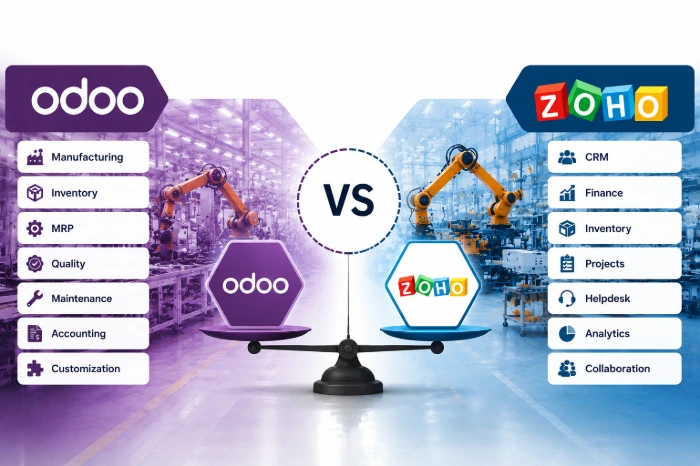
Manufacturing companies need much more than inventory tracking. They require production planning, BOM management, shop-floor visibility, procurement coordination, quality control, and real-time reporting. While both Odoo and Zoho can support manufacturing operations to some extent, their capabilities differ significantly.
(1) Production Planning & Manufacturing Operations:
Odoo Manufacturing (MRP)
Odoo comes with a dedicated Manufacturing module designed specifically for production-driven businesses. It includes:
- Multi-level Bill of Materials (BOM)
- Work Centers Management
- Routing and Operations Planning
- Manufacturing Orders
- Master Production Scheduling (MPS)
- Capacity Planning
- Production Forecasting
- Maintenance Integration
Manufacturers can manage the entire production process—from raw materials to finished goods—in a single system.
Zoho for Manufacturing
Zoho does not offer a dedicated Manufacturing Resource Planning (MRP) module like Odoo. Instead, manufacturers typically rely on a combination of:
- Zoho Inventory
- Zoho Books
- Zoho CRM
- Zoho Analytics
This setup works well for small manufacturers with straightforward processes. However, businesses with complex production workflows, multiple work centers, or detailed production planning may find Odoo more suitable for their needs.
(2) Inventory Management:
Inventory accuracy directly impacts profitability, customer satisfaction, and production efficiency.
Odoo Inventory Features
- Multi-warehouse management
- Barcode scanning
- Batch and lot tracking
- Serial number tracking
- Automated replenishment rules
- Demand forecasting
- Inventory valuation
- Inter-warehouse transfers
Because Odoo’s Inventory module is tightly integrated with Manufacturing, Purchase, and Sales, stock movements are updated automatically across departments.
Zoho Inventory Features
- Warehouse management
- Barcode scanning
- Serial number tracking
- Batch tracking
- Order fulfillment management
- Shipping integrations
- Stock level monitoring
Zoho Inventory is user-friendly and effective for inventory control. However, it lacks the deep manufacturing integration and production-focused workflows available in Odoo.
(3) Quality Control & Compliance:
For manufacturers supplying OEMs, exporters, or large enterprises, quality management is essential.
Odoo Quality Module
Odoo offers a dedicated Quality Management module that enables businesses to:
- Create quality checkpoints
- Define inspection criteria
- Record defects and non-conformities
- Generate quality reports
- Trigger corrective actions
- Monitor quality trends
This is particularly valuable for engineering, automotive, machinery, and industrial manufacturing companies.
Zoho Quality Management
Zoho does not provide a native quality control module comparable to Odoo Quality. Businesses often rely on custom workflows, forms, or third-party applications to manage quality inspections and compliance processes.
Manufacturing Verdict
For small businesses primarily focused on inventory management and order processing, Zoho can be a practical solution.
However, for manufacturers that require production planning, BOM management, quality control, shop-floor visibility, maintenance management, and advanced manufacturing workflows, Odoo offers a more comprehensive ERP ecosystem.
Odoo vs Zoho for Service Businesses
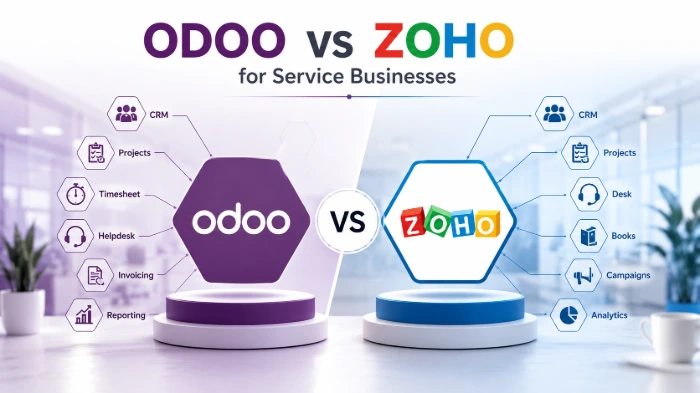
Service companies prioritize customer relationships, project delivery, employee productivity, and recurring revenue management. In this segment, both Odoo and Zoho offer strong capabilities, making the decision more dependent on business size, complexity, and future growth plans.
(1) CRM & Sales Management:
Customer acquisition is the lifeline of every service business.
Zoho CRM
Zoho CRM is widely recognized as one of the strongest CRM solutions available for SMEs. Key features include:
- Lead management
- Opportunity tracking
- Workflow automation
- Email marketing integration
- AI-powered sales insights
- Sales forecasting
- Customer journey tracking
For businesses focused primarily on sales and customer relationship management, Zoho CRM is a strong contender.
Odoo CRM
Odoo CRM offers:
- Lead nurturing
- Opportunity management
- Pipeline visualization
- Automated follow-ups
- Quotation generation
- Sales order integration
- Real-time business dashboards
The major advantage is that CRM data flows directly into Accounting, Projects, Inventory, Field Service, and Helpdesk without requiring multiple software platforms.
(2) Project Management:
Odoo Project
Odoo Project helps service organizations manage:
- Task assignment
- Resource allocation
- Timesheets
- Project profitability
- Milestone tracking
- Customer billing
Its integration with Sales and Accounting helps businesses monitor project costs and profitability in real time.
Zoho Projects
Zoho Projects offers:
- Task management
- Gantt charts
- Team collaboration
- Time tracking
- Document management
- Workflow automation
Many IT companies, consulting firms, and agencies appreciate Zoho Projects for its clean interface and ease of use.
(3) Customer Support & Service Management:
Odoo Helpdesk
Odoo Helpdesk includes:
- Ticket management
- SLA monitoring
- Customer portal
- Knowledge base
- Live chat integration
- Field service integration
It works especially well for businesses that provide on-site services.
Zoho Desk
Zoho Desk is one of Zoho’s strongest products and offers:
- Omnichannel support
- Ticket automation
- Customer self-service portals
- AI-powered assistance
- SLA tracking
- Customer satisfaction monitoring
For organizations focused heavily on customer support, Zoho Desk is often considered one of the best helpdesk solutions available.
Service Business Verdict
If your primary requirement is CRM, customer engagement, helpdesk management, and project collaboration, Zoho provides excellent value.
If you want a unified platform that connects CRM, Projects, Accounting, HR, Helpdesk, Sales, and Field Service under one ERP system, Odoo offers greater long-term scalability and operational visibility.
Feature-by-Feature Comparison
Businesses should evaluate ERP systems based on operational requirements rather than popularity alone.
| Business Function | Winner |
| Manufacturing | Odoo |
| CRM | Tie |
| Accounting | Tie |
| Inventory | Odoo |
| Customization | Odoo |
| Ease of Use | Zoho |
| Project Management | Tie |
| Field Service | Odoo |
| Business Intelligence | Zoho |
| Scalability | Odoo |
Pricing Comparison
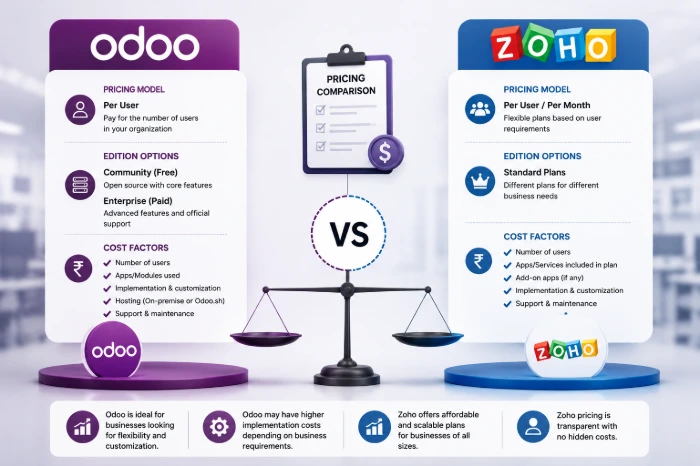
Pricing should be considered based on long-term business needs, not only initial subscription costs.
Odoo Pricing Benefits
- Modular pricing
- Flexible implementation
- Open-source foundation
- Lower customization restrictions
Zoho Pricing Benefits
- Simple subscription model
- Lower entry cost
- Fast deployment
For growing manufacturers, Odoo often delivers better long-term ROI because businesses avoid purchasing multiple third-party solutions later.
Scalability and Customization
As businesses grow, software flexibility becomes increasingly important.Imagine your company grows from:
- 20 employees to 200 employees
- 300 orders per month to 3,000 orders
- Single warehouse to multiple warehouses
Can your ERP handle it?Odoo's modular architecture allows businesses to scale and add features as their needs grow.You can start with:
- CRM
- Sales
- Accounting
Then add:
- Manufacturing
- HR
- Maintenance
- Field Service
- eCommerce
without changing platforms.
Integration Capabilities
Modern businesses require ERP systems that connect with external applications and digital platforms.Odoo integrates with:
- Payment gateways
- eCommerce platforms
- Shipping providers
- Business intelligence tools
- IoT devices
Zoho also offers strong integrations, but typically within the Zoho ecosystem.Businesses requiring advanced manufacturing automation often prefer Odoo.
Implementation Experience in India
Local support, industry knowledge, and implementation expertise significantly impact ERP success.
Indian manufacturers often require:
- GST compliance
- E-Invoicing
- E-Way Bills
- Multi-location operations
- Vendor management
- Production planning
Odoo implementation partners such as Teknovative Solution help businesses configure ERP workflows according to Indian manufacturing requirements.
A successful ERP implementation depends not only on the software but also on how effectively it is implemented.
Real-World Success Story
ERP success is measured by business outcomes, not software installation.
When Jetco Industries, a manufacturer of customized electrical panels, evaluated ERP solutions, the company needed stronger control over production, inventory, purchasing, and financial operations. After implementing Odoo ERP with Teknovative Solution, Sales, Purchase, Inventory, Manufacturing, and Accounting were connected within a single platform.
- Production visibility improved significantly.
- Inventory accuracy increased.
- Purchase planning became proactive.
- Management gained real-time dashboards.
- Cross-department coordination became more efficient.
The result wasn't just better software—it was better business decision-making. Experiencing inventory challenges, production delays, or limited business visibility? Talk to Teknovative Solution to explore how Odoo ERP can help eliminate operational bottlenecks and drive measurable business improvements.
Which ERP Should You Choose?
The right choice depends on your industry, business complexity, and growth plans.
Choose Odoo ERP if you need:
- Manufacturing ERP
- Production planning
- Inventory control
- Quality management
- Maintenance tracking
- High customization
- Long-term scalability
Choose Zoho if you need:
- Strong CRM
- Quick deployment
- Service business management
- Lower initial investment
- Simple cloud applications
For most Indian manufacturing companies, Odoo offers a more complete ERP ecosystem.
For smaller service-based businesses, Zoho can be an excellent starting point.
Conclusion
Choosing between Odoo and Zoho ERP isn't about selecting the most popular software. It's about selecting the platform that matches your business processes today while supporting your growth tomorrow.
If your business revolves around manufacturing, production planning, inventory control, quality management, and operational visibility, Odoo stands out as the stronger choice. Its integrated modules, flexibility, and scalability make it a strong ERP choice for Indian manufacturers.
If your primary focus is CRM, customer engagement, and service management, Zoho remains an excellent option with a user-friendly interface and fast implementation.
The best ERP is the one that solves your real business challenges, supports future growth, and helps your team work smarter every day.
Choosing the Wrong ERP Can Cost More Than You Think
Before you invest in an ERP, understand which platform aligns with your production processes, inventory requirements, service operations, and future growth plans.
Common Queries Answered
For manufacturing companies, Odoo is generally better due to its advanced MRP, inventory, quality control, and production planning capabilities. For service businesses focused on CRM, Zoho is highly competitive.
Yes. Odoo is highly scalable and allows businesses to start with a few modules and expand gradually.
Yes. Odoo can be configured for GST, E-Invoicing, and other Indian business compliance requirements.
Zoho often has a lower entry cost. However, Odoo may provide better long-term value for businesses requiring extensive ERP functionality.
Odoo is generally considered more suitable for manufacturing due to its dedicated Manufacturing, Quality, Maintenance, and Inventory modules.
Yes. Odoo CRM, Sales, Accounting, Inventory, and Manufacturing modules work together within a single platform.
Yes. Odoo offers Project Management, CRM, Helpdesk, Field Service, and Accounting modules designed specifically for service businesses.